
Looking for Q and A about how to make and can homemade spaghetti sauce from fresh tomatoes! in 2025? Scroll down this page and follow the links. And if you bring home some fruit or vegetables and want to can, freeze, make jam, salsa or pickles, see this page for simple, reliable, illustrated canning, freezing or preserving directions. There are plenty of other related resources, click on the resources dropdown above. If you are having a hard time finding canning lids, I've used these, and they're a great price & ship in 2 days.
If you have questions or feedback, please let me know! There are affiliate links on this page. Read our disclosure policy to learn more.
Q and A about how to make and can homemade spaghetti sauce from fresh tomatoes!
Making and canning your own spaghetti sauce is something families remember years later. No store bought spaghetti sauce compares with the taste of that made from your own tomatoes from your garden or fresh-picked from a local farm! In the middle of the winter, you can make a meal with your spaghetti sauce and taste the summer flavor of fresh tomatoes.
- Q. Can you mix the type of tomatoes you have for the sauce? I have several Roma type and also Big Boys. I don't want to use all of my
Roma's on just one type of sauce so I wondered if I could mix the two types since I have a TON of regular tomatoes?
A. Yes, there's no problem mixing types of tomatoes. Of course, the Roma or "paste-type" tomatoes have thicker walls with less water, so they don't need to be cooked down as much to make a thick sauce, but other than that, there's no problem. Use whatever type of tomatoes you have! -
Q. How can I make spaghetti sauce to freeze, instead of can?
A. Easy. Just make the canned sauce as shown above, but instead of canning it, stop after step 8 , let it cool to room temperature, fill the Ziploc bags and freeze it instead!
-
Q. Can I add olive oil or any other oil to the recipe?
A. No, both Ball and the USDA warn that their research shows that adding oil to home canning recipes increases the risk of botulism. If you like the taste oil oil, add it after you open the jars when you go to use them! A tiny amount (like one or 2 tablespoons per batch) used to sautee vegetables is sometimes included in tested recipes.
| McSunley 21.5 quart Water Bath Canner, Stainless Steel Granite Ware 21 QT, 9 Piece Enamelware Water bath Canning Pot with Canning kit, Colander and Rack VKP Brands Water Bath AND Steam Canner, 20 Quart Stainless Steel, flat-bottomed Induction range compatible and safe for smooth top ranges. 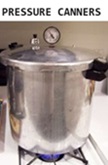
|
Home Canning KitsThis is the same type of standard canner that my grandmother used to make everything from applesauce to jams and jellies to tomato and spaghetti
sauce. This complete kit includes everything you need and lasts for years: the canner, jar rack, Jar grabber tongs, lid lifting wand, a plastic funnel,
labels, bubble freer, and the bible of canning, the Ball Blue Book. It's much cheaper than buying the items separately. You will never need anything else
except jars & lids! To see more canners, of different styles, makes and prices, click here!For more
information and current pricing: |
Summary - Cost of Making Homemade Spaghetti Sauce - makes 7 pint jars, 16 oz each* |
||||
| Item | Quantity | Cost in 2025</ | Source | Subtotal |
| Tomatoes | 20 - 25 lbs (to make about 16 cups of prepared tomato) | free from the garden, or $0.50 cents at a PYO | Garden | $0.00 |
| Canning jars (pint size, wide mouth), includes lids and rings | 7 jars | $8.00/dozen | Grocery stores, like Publix, Kroger and Safeway and local "big box" stores; sometimes Big Lots and even hardware stores | $4.50 |
| seasoning | See step 7 | $2.00? | Grocery stores, like Publix, Kroger and Safeway and local "big box" stores | $2.00 |
| Spaghetti mix | 1 packet | $3.00 per package | Grocery stores, like Publix, Kroger and Safeway and local "big box" stores; sometimes Big Lots and even hardware stores | |
| Total | $6.50 total or about $0.95 per jar INCLUDING the jars - which you can reuse! |
|||
|
* - This assumes you already have the pots, pans, ladles,, and reusable equipment. Note that you can reuse the jars! Many products are sold in jars that will take the lids and rings for canning. For example, Classico Spaghetti sauce is in quart sized jars that work with Ball and Kerr lids and rings. Note that the Classico's manufacturer does not recommend reuse of their jars: see what they have to say on this page: |
||||
Answers to Common Questions
What did I do wrong if my jars spoil?
Tomatoes are a borderline acid / low acid fruit (see this page about tomato acidity for more information) - adding lemon juice helps, processing at least 35 minutes in the water bath canner, or better still, using a Pressure Canner almost eliminates spoilage. If you don't have a Pressure Canner, you must boost the acid level of the sauce, by adding 2 tablespoons of lemon juice or 1/2 teaspoon of citric acid per quart of sauce.
The question everyone asks: Can you add meat?
With a water bath canner, absolutely, definitely NOT. The temperatures do not get high enough to kill the type of bacteria that can attack meat and make you sick, or even kill you. However, with a Pressure Canner, it IS possible. I have complete directions here! I don't do it, simply because... have you ever tasted canned meat? Yes, it is called SPAM. My recommendation is to can without the meat and add fresh browned ground meat or meatballs when you use the sauce!
Meat, Part 2 - I noticed you said it is best not to put meat in the sauce, as it might spoil as a child my mom canned all her meat with nothing but salt in it as she had no freezer. I cannot remember a problem with it going bad. She submerged the jars in a canning pot with a wire rack under it and boiled it for 4 hours always making sure the meat in the jar was covered with water so it would not spoil, also the jars kept covered with water at all times for four hours of boiling. "
It is statistically possible to engage in a very dangerous activity and still experience no harm. For example, one of my father's friends charged the beach at Iwo Jima in World War 2, (definitely, one of the riskiest things you could do) and yet he survived without a scratch, while 7 of 10 of his platoon died. Canning meat in a water bath is the same.
The problem is that Botulism is not killed by temperatures under 240. Water baths only reach 212. You could boil it for 4 days and the botulism would still survive. By the time you ate the jars, enough may not have grow to make you ill. But it is still very, very dangerous.
I could send you dozens and dozens of statements supporting what I stated above from many universities and food authorities. Here is one example from the University of Maine:
Match the canner to the food
There are two types of home canning methods: boiling-water-bath canners and pressure canners. The type of canner that you use should be based upon the type of food you are preserving. According to UMaine Food ScienceSpecialist Beth Calder, fruits, pickled foods, sauerkraut, marmalades, fruit spreads, jams, jellies, fruit butters (except for pumpkin) and salsa can be safely preserved using the water-bath canning method. "However, make sure you use a scientifically tested recipe from a reputable resource," she says.
All other foods should be preserved using a Pressure Canner. This is because botulism-producing bacteria produce spores that can survive boiling water temperatures, but are destroyed using a Pressure Canner with the appropriate time and pressure, which reaches temperatures between 240 and 250 degrees F.
I have read in other homemade spaghetti sauce recipes that you need to cook the mixture for at least 4-5 hours. Is this necessary?
I suppose if you really want to make sure that absolutely no vitamins survive, you could cook it that long! :) The only reason people used to tomato sauce that long was the Roma paste-type tomatoes, with thicker walls, meatier with fewer seeds and less water didn't exist, so they had to cook it for hours to get rid of water and thicken it. And of course, modern sauce mixes that contain a little bit of corn starch as a thickener, also help shorten the time.
How can I make my sauce thicker?
The key is using tomatoes that have less water - Roma types are best. Big Boy's and Beefstakes are very watery. You can boil it down ( a crockpot will
do this without a need to constantly stir). Another simple method is add some canned tomato paste. Beyond that, Clear-gel starch is approved as a thickener for
home canning and works better than corn starch.
And for those who want to go strictly organic and au naturale, my method of squeezing out the excess water and seeds eliminates much of the excess juice (which
you can save as tomato juice for drinking) and lets you start with a thicker tomato pulp which means much shorter cooking time!
(called "corn flour" in the UK)
See here for related tools, equipment, supplies on Amazon
Remember to ALWAYS call the farm or orchard BEFORE you go - weather, heavy picking and business conditions can always affect their hours and crops!
PYO Farms in Other Countries: [ Australia ] [ Canada ] [ South Africa ] [ New Zealand ] [ United Kingdom ]
Our other free, informative sites you may like:
EHSO.com - Environmental health and safety information and guidance for the
home
ConsumerFraudReporting.org - Information about identity theft, frauds and scams; how to report
them and how to protect your identity.
FitnessAndHealthScience.org - Practical fitness, health and diet information that works.
And our other related websites!
Care to Donate to help me keep the website going? Donate to me at Benevia here:
Use the feedback form for questions, comments and feedback
about farms - Use this form suggest a farm to add to the website?
Or as a last result
(I reply to the forms FIRST),write me at

All images and text Copyright ©
Benivia, LLC 2004 - 2012 All rights reserved.
Disclaimer
and Privacy Policy
Permission is given to link to any page on
www.pickyourown.org Do NOT copy and republish this page in whole or part, that is a copyright violation which will be
prosecuted: link to the page instead!
Looking for
jobs on farms? Farmers:
If you'd like to advertise or have your own web page(s), click here!
Remember to ALWAYS call the farm or orchard BEFORE you go - weather, heavy picking and business conditions can always affect their hours and crops!
PYO Farms in Other Countries: [ Australia ] [ Canada ] [ South Africa ] [ New Zealand ] [ United Kingdom ]
Our other free, informative sites you may like:
EHSO.com - Environmental health and safety information and guidance for the
home
ConsumerFraudReporting.org - Information about identity theft, frauds and scams; how to report
them and how to protect your identity.
FitnessAndHealthScience.org - Practical fitness, health and diet information that works.
And our other related websites!
Care to Donate to help me keep the website going? Donate to me at Benevia here:
Use the feedback form for questions, comments and feedback
about farms - Use this form suggest a farm to add to the website?
Or as a last result
(I reply to the forms FIRST),write me at
All images and text Copyright ©
Benivia, LLC 2004 - 2012 All rights reserved.
Disclaimer
and Privacy Policy
Permission is given to link to any page on
www.pickyourown.org Do NOT copy and republish this page in whole or part, that is a copyright violation which will be
prosecuted: link to the page instead!
Looking for
jobs on farms? Farmers:
If you'd like to advertise or have your own web page(s), click here!
Remember to ALWAYS call the farm or orchard BEFORE you go - weather, heavy picking and business conditions can always affect their hours and crops!
PYO Farms in Other Countries: [ Australia ] [ Canada ] [ South Africa ] [ New Zealand ] [ United Kingdom ]
Our other free, informative sites you may like:
EHSO.com - Environmental health and safety information and guidance for the
home
ConsumerFraudReporting.org - Information about identity theft, frauds and scams; how to report
them and how to protect your identity.
FitnessAndHealthScience.org - Practical fitness, health and diet information that works.
And our other related websites!
Care to Donate to help me keep the website going? Donate to me at Benevia here:
Use the feedback form for questions, comments and feedback
about farms - Use this form suggest a farm to add to the website?
Or as a last result
(I reply to the forms FIRST),write me at
All images and text Copyright ©
Benivia, LLC 2004 - 2012 All rights reserved.
Disclaimer
and Privacy Policy
Permission is given to link to any page on
www.pickyourown.org Do NOT copy and republish this page in whole or part, that is a copyright violation which will be
prosecuted: link to the page instead!
Looking for
jobs on farms? Farmers:
If you'd like to advertise or have your own web page(s), click here!
Remember to ALWAYS call the farm or orchard BEFORE you go - weather, heavy picking and business conditions can always affect their hours and crops!
PYO Farms in Other Countries: [ Australia ] [ Canada ] [ South Africa ] [ New Zealand ] [ United Kingdom ]
Our other free, informative sites you may like:
EHSO.com - Environmental health and safety information and guidance for the
home
ConsumerFraudReporting.org - Information about identity theft, frauds and scams; how to report
them and how to protect your identity.
FitnessAndHealthScience.org - Practical fitness, health and diet information that works.
And our other related websites!
Care to Donate to help me keep the website going? Donate to me at Benevia here:
Use the feedback form for questions, comments and feedback
about farms - Use this form suggest a farm to add to the website?
Or as a last result
(I reply to the forms FIRST),write me at
All images and text Copyright ©
Benivia, LLC 2004 - 2012 All rights reserved.
Disclaimer
and Privacy Policy
Permission is given to link to any page on
www.pickyourown.org Do NOT copy and republish this page in whole or part, that is a copyright violation which will be
prosecuted: link to the page instead!
Looking for
jobs on farms? Farmers:
If you'd like to advertise or have your own web page(s), click here!