Looking for How to Make Homemade Pickled Okra (Pickled Dilled Okra) Easily! With Step-by-step Photos, Recipe, Directions, Ingredients and Costs in 2024? Scroll down this page and follow the links. And if you bring home some fruit or vegetables and want to can, freeze, make jam, salsa or pickles, see this page for simple, reliable, illustrated canning, freezing or preserving directions. There are plenty of other related resources, click on the resources dropdown above. If you are having a hard time finding canning lids, I've used these, and they're a great price & ship in 2 days.
If you have questions or feedback, please let me know! There are affiliate links on this page. Read our disclosure policy to learn more.
How to Make Homemade Pickled Okra (Pickled Dilled Okra) Easily! With Step-by-step Photos, Recipe, Directions, Ingredients and Costs
Making Homemade Pickled Dilled Okra
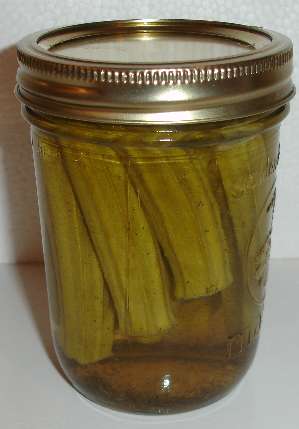 Making
and canning your own pickled dilled okra is one of the easiest things you can do
with your okra to preserve it for later use! Here's how to do it, in easy
steps and completely illustrated. This method is so easy, ANYONE can
do this! It yields 8 to 9 pints.
Making
and canning your own pickled dilled okra is one of the easiest things you can do
with your okra to preserve it for later use! Here's how to do it, in easy
steps and completely illustrated. This method is so easy, ANYONE can
do this! It yields 8 to 9 pints.
Ingredients and Equipment
|
|
Process - How to Make Pickled Okra
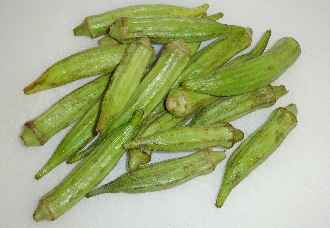
Step 1 - Selecting the okraIt's fun to go pick your own and you can obviously get better quality okra! At right is a of picture okra from my garden - it is SO easy to grow.
|
|
||||||||||||
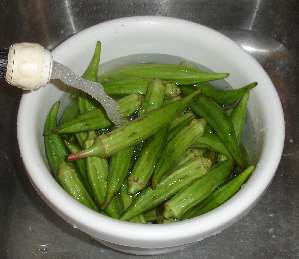
Step 2 - How much okra?It takes about 1 lb of okra to fill a pint jar. Step 3 -Wash and cut the okra!I'm sure you can figure out how to wash the fruit in plain cold water. You will need to cut the ends off (about 1/4-inch). |
|
||||||||||||
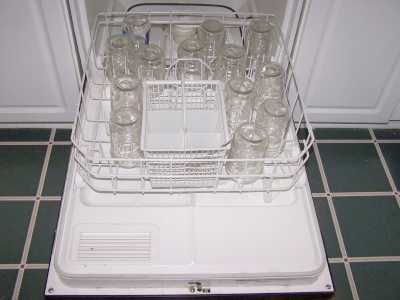 |
Step 4 - Get the jars and lids sanitizingThe dishwasher is fine for the jars; especially if it has a "sanitize" cycle. I get that going while I'm preparing everything else, so it's done by the time I'm ready to fill the jars. Be sure to let it go through the rinse cycle to get rid of any soap! It's also a good time to start heating up the water in the canner and the small pan of water to warm the lids to soften the adhesive.
|
||||||||||||
|
Lids: put the very hot (but not quite boiling; around 180 F,
steaming water is fine)
|
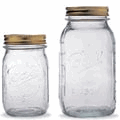
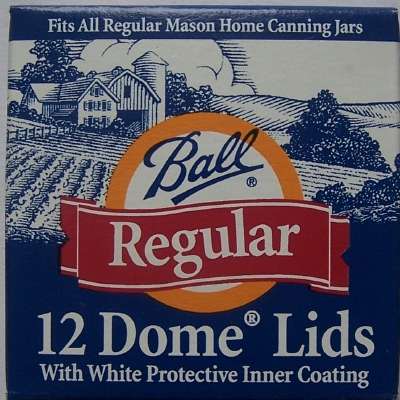  Need lids, rings and replacement jars? Get them all here, delivered direct to your home, at the best prices on the internet! |
||||||||||||
|
|
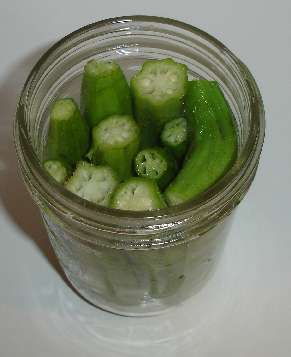
Step 5 - Fill the jars with okraFill jars firmly with whole okra, leaving 1/2-inch headspace. |
||||||||||||
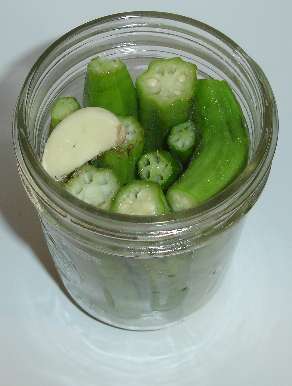
Step 6 - Add the GarlicPlace 1 garlic clove in each jar. |
 |
||||||||||||
|
|
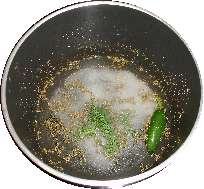
Step 7 - Mix and heat the other ingredientsCombine the salt, hot peppers, dill seed, water, and vinegar in large saucepan and bring to a boil. Be sure to use a NON-metal pot - or a coated metal (teflon, silverstone, enamel, etc.) without breaks in the coating. the metal reacts with the vinegar and makes the pickle solution turn cloudy. |
||||||||||||
Step 8 - Fill the jars with solution and put the lid and rings onPour hot pickling solution over okra, leaving 1/4 to 1/2-inch headspace. You will notice that it appears to be bubbling as the solution percolates down inside the okra, which have cavities. You will need to wait a few minutes and add more solution. then seat the lid and hand-tighten the ring around them. |
|
||||||||||||
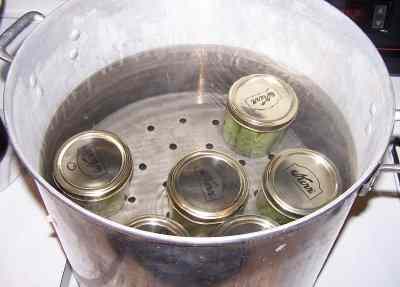
Step 9 - Boil the jars in the cannerPut the jars in the canner and keep them covered with at least 1 inch of water. Keep the water boiling. Boil them for 10 minutes. Remember to adjust for altitudes and larger jars - see the table below!
|
 |
||||||||||||
|
|
Step 9 - DoneLift the jars out of the water and let them cool without touching or bumping them in a draft-free place (usually takes overnight) You can then remove the rings if you like, but if you leave them on, at least loosen them quite a bit, so they don't rust in place due to trapped moisture. Once the jars are cool, you can check that they are sealed verifying that the lid has been sucked down. Just press in the center, gently, with your finger. If it pops up and down (often making a popping sound), it is not sealed. If you put the jar in the refrigerator right away, you can still use it. Some people replace the lid and reprocess the jar, then that's a bit iffy. If you heat the contents back up, re-jar them (with a new lid) and the full time in the canner, it's usually ok. When can you start eating the okra? Well, it takes some time for the seasonings to be absorbed into the pickles. Generally, that's about 2 or 3 days! Ah... the wait...
|
||||||||||||
|
|
|||||||||||||
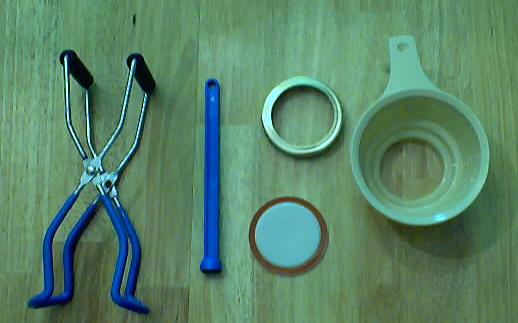
Other Equipment:From left to right:
|
 |
||||||||||||
Summary - Cost of Making Homemade Pickled Okra - makes 14 pint jars, 16 oz each* |
||||
| Item | Quantity | Cost in 2024 | Source | Subtotal |
| Okra | 7 lbs | free from the garden, or $3.00 cents at a PYO | Pick your own | $3.00 |
| Canning jars (pint size, wide mouth), includes lids and rings | 12 jars | $8.00/dozen | Grocery stores (Publix, Kroger, Safeway, etc.) | $9.33 |
| Vinegar | 6 cups | $0.99 | Safeway, Publix, Kroger, grocery stores |
$0.99 |
| Garlic, dill, peppers |
|
about $3.00 | Grocery stores (Publix, Kroger, Safeway, etc.) | $3.00 |
| Total | $16.33 total or about $1.16 per jar INCLUDING the jars - which you can reuse! |
|||
|
* - This assumes you already have the pots, pans, ladles,, and reusable equipment. Note that you can reuse the jars! Many products are sold in jars that will take the lids and rings for canning. For example, Classico Spaghetti sauce is in quart sized jars that work with Ball and Kerr lids and rings. Note that the Classico's manufacturer does not recommend reuse of their jars: see what they have to say on this page: |
||||
How to make other pickles - recipes and instructions:
- Cucumber pickles (quick process, canned)
- Refrigerator pickles (no canning required)
- Cucumber pickle relish
- Pickled beets
- Pickled green beans
Canning processing times
|
Type of pickling method |
Jar size | 0 to 1,000 ft above sea level | 1,001 to 6,000 ft above sea level |
| Quick process, (raw okra put in the jar, hot liquid poured over them)- | pint | 10 min | 15 min |
| Quick process, (raw okra put in the jar, hot liquid poured over them)- | quart | 10 min | 15 min |
Answers to Common Questions
What did I do wrong if my pickles aren't crisp or
crunchy?
You probably used overripe cucumbers or didn't measure the vinegar and water
accurately. Of course, processin gtoo long in the boiling water bath can do it,
too!
Why are my pickles cloudy?
There are a variety of possible causes for cloudy pickles:
In nonfermented pickles (fresh pack), cloudiness might indicate spoilage. Yeast growth may also make pickles cloudy or slimy. Check the pickles for signs of off-odors and mushiness of the pickles. If yeast growth is evident, discard the pickles. If these signs are absent, the pickles are (absent other problems) safe to eat.
Be sure to use a NON-metal pot - or a coated metal (teflon, silverstone, enamel, etc.) without breaks in the coating. the metal reacts with the vinegar and makes the pickle solution turn cloudy. This is the most common cause of cloudy pickles. There is no danger to these pickles, though!
Sometimes the fillers (anticaking agents) in regular table salt may cause slight cloudiness, so always use pickling salt. Obviously, if you used a packet mix (like Mrs. Wages) this should not be a problem.
Hard water might also cause cloudiness. If soft water is not available, boil the hard water and let it sit undisturbed overnight. Pour off the top portion and use it in the pickling solution.

Looking for canning equipment and supplies?
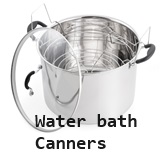
Water bath canner with a jar rack
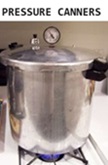
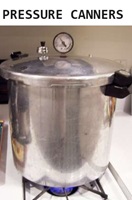
Pressure canners for gas, electric and induction stoves: Presto 23Qt or T-fal 22Qt
Canning scoop (this one is PERFECT)
Ball Blue book (most recent version)
Jars: 8oz canning jars for jams
Find Other types of farms:
Farm markets and roadside stands
Road trips and camping resources
Local Honey, apiaries, beekeepers
Consumer fraud and scams information
Home canning supplies at the best prices on the internet!
Maple Syrup Farms, sugarworks, maple syrup festivals
Environmental information and resources
Farms For Your Event for birthday parties, weddings, receptions, business meetings, retreats, etc.
Festivals - local fruit and vegetable festivals
Get the
most recent version of
the Ball Blue Book