Looking for How to can your own homemade canned pickled beets (complete directions with photos ) in 2025? Scroll down this page and follow the links. And if you bring home some fruit or vegetables and want to can, freeze, make jam, salsa or pickles, see this page for simple, reliable, illustrated canning, freezing or preserving directions. There are plenty of other related resources, click on the resources dropdown above. If you are having a hard time finding canning lids, I've used these, and they're a great price & ship in 2 days.
If you have questions or feedback, please let me know! There are affiliate links on this page. Read our disclosure policy to learn more.
How to can your own homemade canned pickled beets (complete directions with photos )
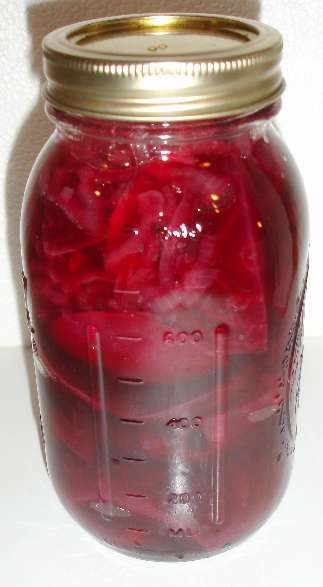
How to Make Homemade Canned Pickled Beets
Click here for a PDF print version
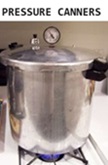
You think making and canning your own pickled beets is difficult or expensive? Not at all! You can do it with basic equipment already in your kitchen - you just need a canning pot. And thanks to the vinegar in pickled beets, you can use either a plain open water bath pot or a Pressure Canner (which will also let you can low acid vegetables!)
So, here's how to can pickled beets! The directions are complete with instructions in easy steps and completely illustrated. In the winter when you open a jar, the pickled beets will taste MUCH better than any store-bought canned pickled beets! For those of you looking to can "Harvard beets" (which are, essentially, pickled beets with cornstarch added to thicken the liquid), just make these pickled beets, then when you are ready server, heat them and add a little cornstarch. Cornstarch is not recommended for using in canning recipes due to its effect on heat transfer, so it is better to add it at serving time!
Prepared this way, the jars have a shelf life of about 12 months, and aside from storing in a cool, dark place, require no special attention.
Directions for Making Canned Pickled Beets
Ingredients
- 7 to 8 lbs of Beets (see step 1)
- 4 cups vinegar (5% acidity)
- 11/2 teaspoons canning or pickling salt
- 2 cups sugar - You can make them without sugar using Stevia / Truvia or Splenda, see that recipe here.
- 2 cups water
- 2 cinnamon sticks
- 12 whole cloves - about 1 tsp
- 12 allspice nuts (whole) - about 1 tsp
- 4 to 6 onions (approximately 2 to 21/2-inch in diameter) (optional)
Equipment
- Jar grabber (to pick up the hot jars)
- Jar funnel ($4 at mall kitchen stores and local "big box" stores, but it's usually cheaper online from our affiliates)
- At least 1 large pot
- Large spoons and ladles,
- Canning jars (often called Ball jars, Mason jars or Kerr jars) (Publix, Kroger, other grocery stores and some "big box" stores carry them - about $7 per dozen pint jars including the lids and rings)
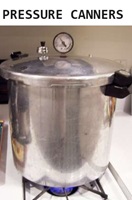
- 1 Water Bath Canner OR a Pressure Canner (a large pressure pot with a lifting rack to sanitize the jars after filling about $75 to $200 at mall kitchen stores and "big box" stores, but it is cheaper online; see this page for more about pressure canners).
Recipe and Directions
Step 1 - Selecting the beets
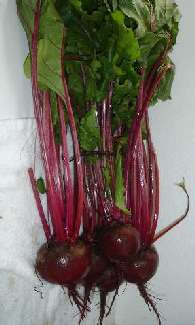 The
most important step! You need beets that are FRESH and crisp.
Limp, old beets will make nasty tasting canned beets. Guests will
probably throw them at you.. Select firm, crisp beets. Remove and
discard any soft, diseased, spotted and chewed up beets.
The
most important step! You need beets that are FRESH and crisp.
Limp, old beets will make nasty tasting canned beets. Guests will
probably throw them at you.. Select firm, crisp beets. Remove and
discard any soft, diseased, spotted and chewed up beets.
How many beets and where to get them
You can grow your own, pick your own, or buy them at the grocery store. About 7 pounds of 2- to 21/2-inch diameter beets makes about 8 pints of pickled beets. I wouldn't use canned beets; what's the point: Most of the flavor is gone from them, and you can always get fresh beets.
Step 2 - Prepare the jars and canner
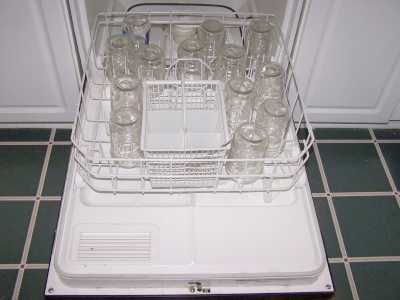 Wash
the jars and lids
Wash
the jars and lids
This is a good time to get the jars ready! The dishwasher is fine for the jars; especially if it has a "sanitize" cycle. Otherwise put the jars in boiling water for 10 minutes. I just put the lids in a small pot of almost boiling water for 5 minutes, and use the magnetic "lid lifter wand" (available from target, other big box stores, and often grocery stores; and available online - see this page) to pull them out.
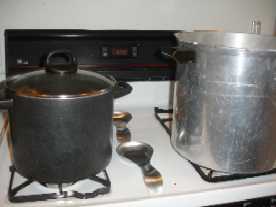
Get the canner heating up
Rinse out your canner, put the rack in the bottom, and fill it with hot tap water. (Of course, follow the instruction that came with the canner, if they are different). Put it on the stove over low heat just to get it heating up for later on.
Step 3 - Trim the ends and cut into smaller pieces
Just take a sharp knife and trim off beet tops, leaving an inch of stem and roots to prevent bleeding of color.
Step 4 -Wash the beets!
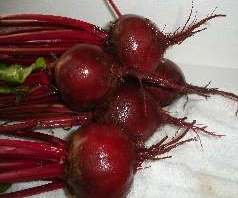 I'm
sure you can figure out how to scrub the beets in plain cold or lukewarm
water using your hands or a vegetable brush.
I'm
sure you can figure out how to scrub the beets in plain cold or lukewarm
water using your hands or a vegetable brush.
Step 5 - Cook the beets
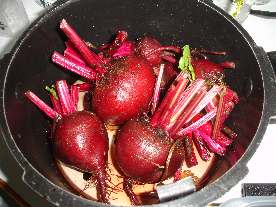 Put
similar sized beets (hopefully, they're ALL of a similar size so they take
the same time to cook) together with enough boiling water to cover them
and cook until tender (usually about 30 to 45 minutes in an open pot, or
10 - 15 minutes in a pressure cooker).
Put
similar sized beets (hopefully, they're ALL of a similar size so they take
the same time to cook) together with enough boiling water to cover them
and cook until tender (usually about 30 to 45 minutes in an open pot, or
10 - 15 minutes in a pressure cooker).
Drain and discard the liquid (it would weaken the pickling solution).
Step 6 - Cool the beets
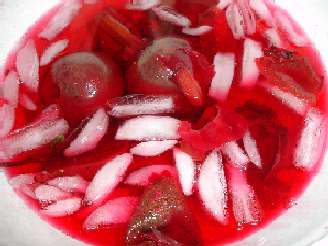 You
can pour ice over them, or just let them cool on their own. It's
just to cool them enough so you can handle them to remove the skins,
stems, roots and then slice or quarter them.
You
can pour ice over them, or just let them cool on their own. It's
just to cool them enough so you can handle them to remove the skins,
stems, roots and then slice or quarter them.
Step 7 - Trim, peel and slice
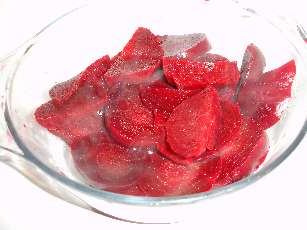 Trim
off the roots and stems. The skins should easily slide off. Slice the
beets into 1/4-inch slices. You can leave the beets whole (if they are
small, say 1 inch or less), or quarter them or slice them into 1/4-inch
slices. This is to help more fit in the jars and to help the
seasoning to penetrate them better.
Trim
off the roots and stems. The skins should easily slide off. Slice the
beets into 1/4-inch slices. You can leave the beets whole (if they are
small, say 1 inch or less), or quarter them or slice them into 1/4-inch
slices. This is to help more fit in the jars and to help the
seasoning to penetrate them better.
Step 8 - (Optional) Slice the onions.
If you like onions in the mix (most people do), peel and thinly slice the onions.
Step 9 - Make the Pickling Solution
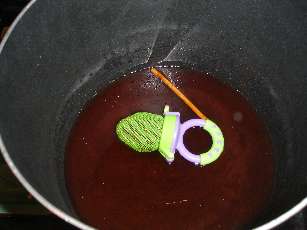 Combine
the vinegar, salt, sugar (or Stevia (in a prepared form like Truvia, it measures same as sugar; if you use another form, you will need do your own conversion) - or Splenda, if you prefer, if you need a no-sugar version) and fresh water in a large pot.
Put the spices in cheesec
Combine
the vinegar, salt, sugar (or Stevia (in a prepared form like Truvia, it measures same as sugar; if you use another form, you will need do your own conversion) - or Splenda, if you prefer, if you need a no-sugar version) and fresh water in a large pot.
Put the spices in cheesec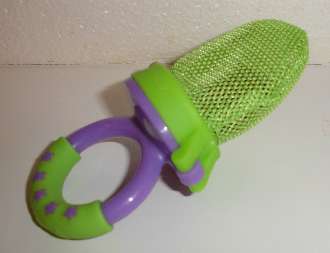 loth
bag and add to vinegar mixture. Bring to a boil.
loth
bag and add to vinegar mixture. Bring to a boil.
Here's a great trick for the spices: get a baby food holder like this one, available at Target and any baby supplies store. It is made of plastic, and can hold the spices for easy removal later. It's reusable and has no metal, so it won't react with the vinegar!
 Step
10 - Heat the mixture with the beets and onions
Step
10 - Heat the mixture with the beets and onions
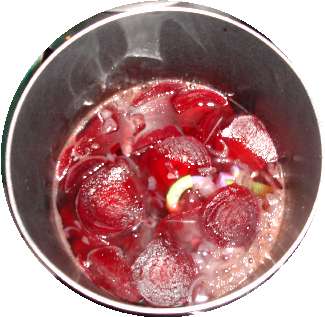
Add beets and onions to the pot and simmer for 5 minutes. Then remove the spice bag.
Step 11 - Packing the beets in the canning jars
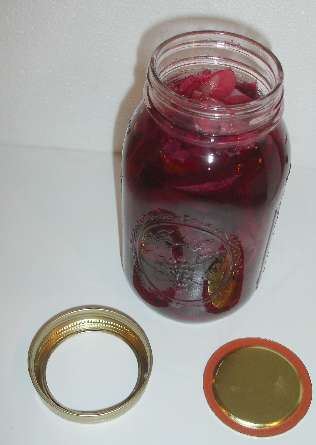 This
is called "hot packing"! Fill the jars with beets and onions, leaving
1/2-inch headspace. Pack the jars fairly tightly, but be sure to leave
1/2-inch of space at the TOP of the jar. That is called "headspace"
and is needed for expansion during heating in the water bath.
This
is called "hot packing"! Fill the jars with beets and onions, leaving
1/2-inch headspace. Pack the jars fairly tightly, but be sure to leave
1/2-inch of space at the TOP of the jar. That is called "headspace"
and is needed for expansion during heating in the water bath.
Step 12 - Pour boiling cooking liquid into each packed jar
Use a ladle or Pyrex measuring cup to carefully fill each packed jar with the hot vinegar solution, again allowing 1/2-inch headspace. The beets should be covered and there should still be 1/2 inch of airspace left in the top of each jar. Be careful not to burn yourself, (or anyone else - children should be kept back during this step!)
Step 13 - Put the lids and rings on
Put the lids on each jar and seal them by putting a ring on and screwing it down snugly (but not with all your might, just "snug").
Step 14 - Put the jars in the canner and the lid on the canner
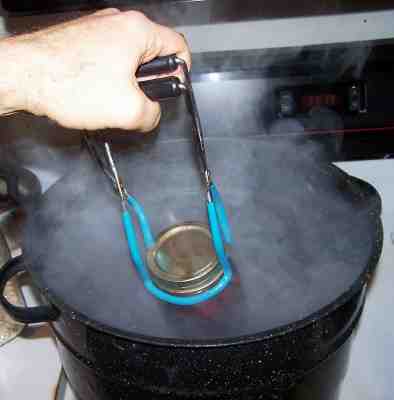 Using
the jar tongs, put the jars on the rack in the canner. Make sure
the tops of the jars are covered by at least 1 inch of water.
Using
the jar tongs, put the jars on the rack in the canner. Make sure
the tops of the jars are covered by at least 1 inch of water.
Step 15 - Process for 30 minutes*
The chart below will help you determine the right processing time and pressure, if you have a different type of canner, or are above sea level. For most people, using a plain open water bath canner, the time will be 30 to 35 minutes. You can use either a plain water bath canner OR a pressure canner, since the vinegar adds so much acidity (if you can vegetables other than tomatoes without adding vinegar, you must use a pressure canner).
*Recommended Processing times For Pickled Beets in A Boiling Water (Open) Bath Canner |
||||||
|
PROCESS TIMES (MIN) AT ALTITUDES OF: |
||||||
| Canned Product | Style of Pack | Jar Size | 0-1000 ft. | 1001-3000 ft. | 3001-6000 ft. | Above 6000 ft. |
| Pickled Beets | Hot | Pints or Quarts | 30 | 35 | 40 | 45 |
Recommended process time for beets in a dial-gauge pressure canner. |
|||||
| Canner Pressure (PSI) at Various Altitudes for Dial-Type Pressure Canners | |||||
| Jar Size | Process Time | 0 - 2,000 ft | 2,001 - 4,000 ft | 4,001 - 6,000 ft | 6,001 - 8,000 ft |
| Pints | 30 min | 11 lb | 12 lb | 13 lb | 14 lb |
| Quarts | 35 | 11 | 12 | 13 | 14 |
Step 16 - Remove the jars
Lift
the jars out of the water and let them cool on a wooden cutting board or
a towel, without touching or bumping them in a draft-free place
(usually takes overnight), here they won't be bumped. You can then
remove the rings if you like, but if you leave them on, at least loosen
them quite a bit, so they don't rust in place due to trapped moisture.
Once the jars are cool, you can check that they are sealed verifying that the lid has been sucked down. Just press in the center, gently, with your finger. If it pops up and down (often making a popping sound), it is not sealed. If you put the jar in the refrigerator right away, you can still use it.
Some people replace the lid and reprocess the jar, if you do it with 24 hours. You heat the contents back up, re-jar them (with a new lid) and the full time in the canner. You're done!
Other Equipment:
From left to right: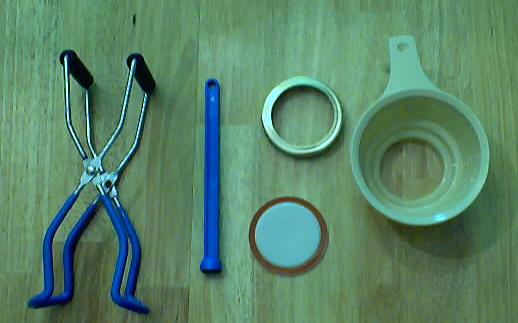
- Jar lifting tongs to pick up hot jars
- Lid lifter - to remove lids from the pot of boiling water (sterilizing )
- Lids- disposable - you may only use them once
- Ring - holds the lids on the jar until after the jars cool - then you remove them, save them and reuse them
- Canning Jar funnel - to fill the jars
Frequently Asked Questions
Q. Is it safe to can pickled beets in a traditional water bath? If so how long do you do process them?
A. Yes! Pickled vegetables have added vinegar which adds acid and lowers the pH, making it safe to can in a water bath canner,(or a Pressure Canner) The table above provides the USDA and Ball recommended processing times for both a water bath canner and a Pressure Canner.

Looking for canning equipment and supplies?
Water bath canner with a jar rack
Pressure canners for gas, electric and induction stoves: Presto 23Qt or T-fal 22Qt
Canning scoop (this one is PERFECT)
Ball Blue book (most recent version)
Jars: 8oz canning jars for jams
Find Other types of farms:
Farm markets and roadside stands
Road trips and camping resources
Local Honey, apiaries, beekeepers
Consumer fraud and scams information
Home canning supplies at the best prices on the internet!
Maple Syrup Farms, sugarworks, maple syrup festivals
Environmental information and resources
Farms For Your Event for birthday parties, weddings, receptions, business meetings, retreats, etc.
Festivals - local fruit and vegetable festivals
Get the
most recent version of
the Ball Blue Book