
Looking for Making Homemade Crisp Crunchy Pickles in 2025? Scroll down this page and follow the links. And if you bring home some fruit or vegetables and want to can, freeze, make jam, salsa or pickles, see this page for simple, reliable, illustrated canning, freezing or preserving directions. There are plenty of other related resources, click on the resources dropdown above. If you are having a hard time finding canning lids, I've used these, and they're a great price & ship in 2 days.
If you have questions or feedback, please let me know! There are affiliate links on this page. Read our disclosure policy to learn more.
Making Homemade Crisp Crunchy Pickles
Making Homemade Crisp Crunchy Pickles
Using the "low temperature process" method
Making and canning your own crisp, crunchy pickles, gherkins, kosher dills, bread and butter, sweet pickles, etc. is one of the easiest things you can do with produce! Here's how to do it, in easy steps and completely illustrated. It is much faster than the old method your grandmother used with tons of pickling salt and de-scumming the brine! Ugh! This method is so easy, ANYONE can do this! It's a great thing to do with your kids! I'm experimenting with the various techniques, such as soaking the cucumbers overnight in lime solution first, using "pickle crisp" etc. I'' revise this page as I taste the results in the weeks to come!
Types of Pickles
- Fresh-pack (or quick process) pickles are cured for several hours in a vinegar solution or are immediately combined with hot vinegar, spices, and seasonings. Examples include dills, bread-and-butter pickles and pickled beets. Quick Process is what these instructions (below on this page) show.
Other types are:
- Fermented pickles are vegetables soaked in a brine solution for 4 to 6 weeks. During this time, lactic acid bacteria, naturally present on the surface of vegetables, grows. Other microbes are inhibited by salt. The color of the vegetables changes from bright green to olive/yellow-green, and the white interior becomes translucent. Examples include dill pickles and sauerkraut.
- Refrigerated dills are cucumbers marinated for 1 day to 1 week in a salt and spice brine (in the fridge) and then stored in the refrigerator for up to 2 months. No canning is required! See this page for refrigerated dill pickle directions!
- Fruit pickles are whole or sliced fruit simmered in a spicy, sweet-sour syrup. Examples include spiced peaches and crabapples. See this page for directions to make spiced peaches!
- Relishes are made from chopped fruits or vegetables that are cooked to a desired consistency in a spicy vinegar solution. Examples include corn relish and horseradish. See this page for cucumber pickle relish directions!
- NEW! Low salt / reduced salt dill pickles
Ingredients and Equipment
|
|
Directions - How to Make Pickles
Step 1 - Selecting the cucumbers
 It's
fun to go pick your own and you can obviously get better quality
cucumbers!
It's
fun to go pick your own and you can obviously get better quality
cucumbers!
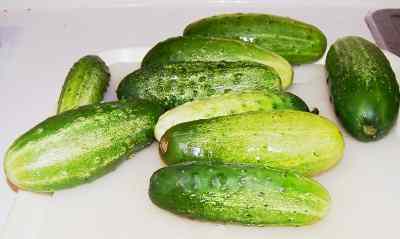
At right is a of picture cucumbers from my garden - they are SO easy to grow. But be sure to grow the varieties that are labeled "pickling cucumbers" - they will be much more crisp!
 The
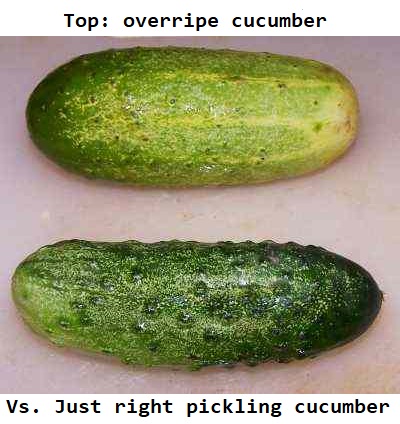
picture at right shows a good cucumber for pickling (bottom) and a bad one
(top). The good one is dark green, firm, and not bloated. It has
lots of warts!
The
picture at right shows a good cucumber for pickling (bottom) and a bad one
(top). The good one is dark green, firm, and not bloated. It has
lots of warts!
The bad one is overripe, it has yellow or white areas in the skin, and the warts are almost all gone. If you cut it open, you will see developed seeds. You don't want seeds!
For cucumber pickles, use cucumbers intended for pickling that are no more then 2 inches in diameter. Start with crisp raw vegetable varieties to get crisp pickled vegetables.
The most important factor in getting crisp pickled vegetables is to start with fresh, just-picked vegetables. Overripe cucumbers make mushy pickles. Vegetables become soft as their pectin structure changes due to microbial activity, excess heat or improper handling. As each day passes, vegetables lose crispness. Once a vegetable is soft it cannot be made firm again.
Step 2 - How many cucumbers?
It takes about 3 or 4 cucumbers to fill a pint jar. Each cucumber is about 4 - 5 inches long and you will cut off the ends so they will fit with 1/4-inch to spare..
Step 3 -Wash and cut the vegetables!
 I'm
sure you can figure out how to wash the fruit in plain cold water.
I'm
sure you can figure out how to wash the fruit in plain cold water.
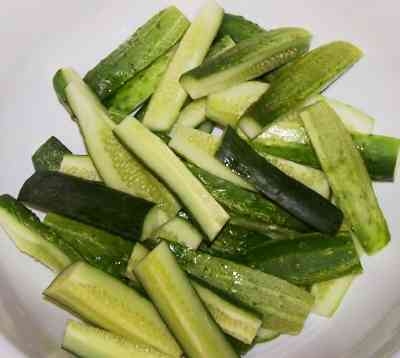
You will need to cut the ends off (about 1/4-inch, the blossom harbors microbes that can cause softening. ) and then slice them lengthwise if you like spears.
You can also leave them whole or cut them cross-wise for bread-and-butter pickles.
Set them aside for use in step 7.
Step 4 - Get the jars and lids sanitizing
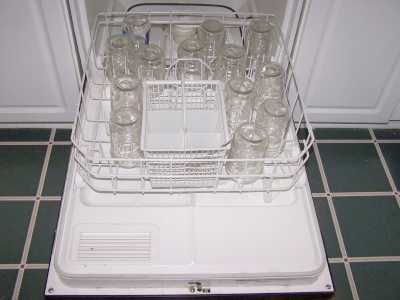
The dishwasher is fine for the jars; especially if it has a "sanitize"
cycle. I get that going while I'm preparing everything else, so it's
done by the time I'm ready to fill the jars. If you don't have a
dishwasher, submerge the jars in a large pot (the canner itself) of water
and bring it to a boil.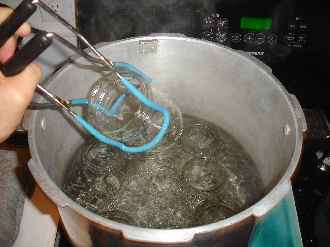
Be sure to let it go through the rinse cycle to get rid of any soap!
Get the canner heating up
Fill the canner about 1/2 full of water and start it heating (with the lid on).
Start the water for the lids
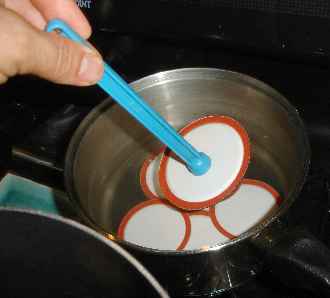 Put
the lids into a pan of hot, but not quite boiling water for at least several minutes.
Note: everything gets sanitized in the water bath (step 7) anyway, so this just
helps to ensure there is no spoilage later!)
Put
the lids into a pan of hot, but not quite boiling water for at least several minutes.
Note: everything gets sanitized in the water bath (step 7) anyway, so this just
helps to ensure there is no spoilage later!)
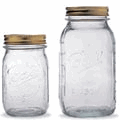
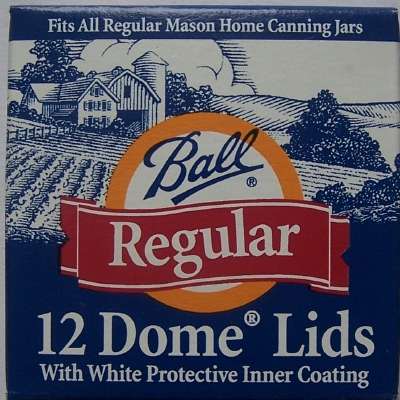
 Need
lids, rings and replacement jars?
Need
lids, rings and replacement jars?
Get them all here, delivered direct to your home, at the best prices on the internet!
Step 5 - Mix the vinegar with the pickling mix and bring to a near boil
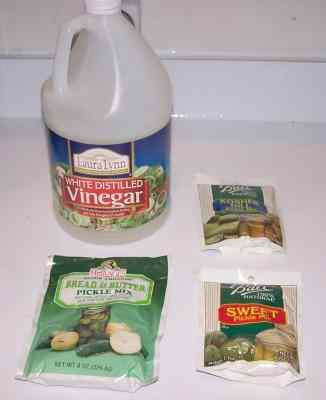 OK,
you can
make your own pickling
mix from spices, salt, dill, etc.; but it is MUCH more time-consuming,
complicated, and prone to problems. This method produces pickles
which are just as crisp - as long as you pick very firm cucumbers.
The keys are:
OK,
you can
make your own pickling
mix from spices, salt, dill, etc.; but it is MUCH more time-consuming,
complicated, and prone to problems. This method produces pickles
which are just as crisp - as long as you pick very firm cucumbers.
The keys are:
- cutting of 1/8 inch of the blossom end (the opposite from the stem end),
- Brining the cucumbers, and
- if you do not remove the blossom end, add 2 grape leaves to every jar (I kid you not, they have something in them that makes the pickles crunchier, by neutralizing the enzyme n the blossom end that makes the cukes soft).
The stores (grocery stores, like Publix, Kroger and Safeway and local "big box" stores, sometimes even local hardware stores) sell several varieties of mixes - Kosher dill, bread-and-=butter and sweet pickles are the most commonly seen. And be sure to get them by July - they tend not to re-order them when they sell out. Mrs. Wages "quick process refrigerator pickle mixes" are the easiest, as they do not even require a water bath canner (but must be stored in the fridge!). The others require canning as shown in these instructions, and may be stored on the shelf.
Pickle Mixes
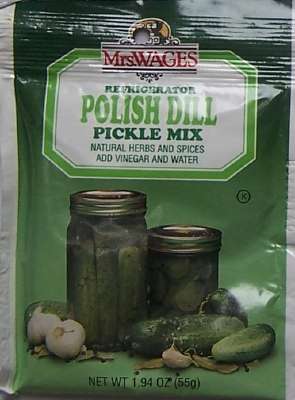 To
interject a crass commercial here - hey, I've got to pay for the website
somehow :) I have found the best (crispest, best tasting) pickles from
a mix are with the "Mrs. Wages Polish Dill Refrigerator Pickle Mix" They
REALLY are good AND you don't need a canner - you store them in your fridge
right after making them. They're ready to eat in 24 hours! Our
affiliate sells the mixes (and at really good prices, too)
To
interject a crass commercial here - hey, I've got to pay for the website
somehow :) I have found the best (crispest, best tasting) pickles from
a mix are with the "Mrs. Wages Polish Dill Refrigerator Pickle Mix" They
REALLY are good AND you don't need a canner - you store them in your fridge
right after making them. They're ready to eat in 24 hours! Our
affiliate sells the mixes (and at really good prices, too)
Whether you want dills or sweet pickles; canning them or straight into the refrigerator; there is a mix for every taste and need here!Get them all here, delivered direct to your home, at the best prices on the internet! Get everything you need to make pickles: mixes, salt, brine, etc. here!
Step 6 - Heat the pickle mix
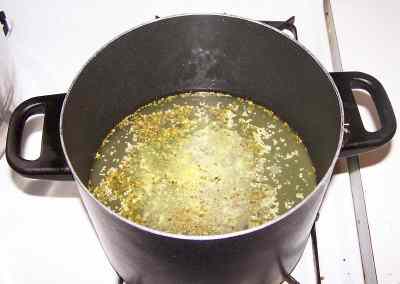 Bring
the mix and vinegar to a near-boil - just simmering! The directions on the
packet will tell you how much vinegar to add, it's usually about 4 cups
Bring
the mix and vinegar to a near-boil - just simmering! The directions on the
packet will tell you how much vinegar to add, it's usually about 4 cups
Be sure to use a NON-metal pot - or a coated metal (teflon, silverstone, enamel, etc.) without breaks in the coating. the metal reacts with the vinegar and makes the pickle solution turn cloudy.
Step 7 - Fill the jars with cucumbers and put the lid and rings on
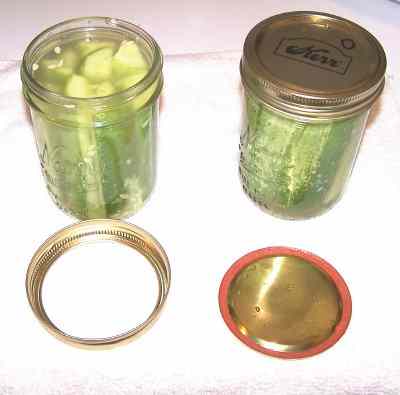 Pack
the raw cucumbers from step 3, whole or slices in and pour the simmering
pickle mix liquid over them. Fill them to within 1/4-inch of the top, seat
the lid and hand-tighten the ring around them.
Pack
the raw cucumbers from step 3, whole or slices in and pour the simmering
pickle mix liquid over them. Fill them to within 1/4-inch of the top, seat
the lid and hand-tighten the ring around them.
Step 8 - Process the jars in the canner
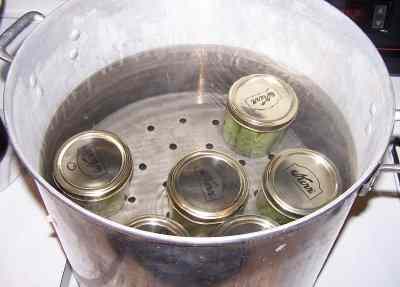 Put
them in the canner and keep them covered with at least 1 inch of water.
Keep the water boiling until you are ready to process. Then, here's the
key to crisp pickles: Cucumber pickles should be processed for at
180-185°F, which is obviously below boiling (212 F), but hot enough to
kill bacteria. Check with a thermometer to be certain that the water
temperature remains above 180° during the entire processing time. But
keep the temperature below 185° to avoid breaking down the pectin, which
will cause softening of the pickle.
Put
them in the canner and keep them covered with at least 1 inch of water.
Keep the water boiling until you are ready to process. Then, here's the
key to crisp pickles: Cucumber pickles should be processed for at
180-185°F, which is obviously below boiling (212 F), but hot enough to
kill bacteria. Check with a thermometer to be certain that the water
temperature remains above 180° during the entire processing time. But
keep the temperature below 185° to avoid breaking down the pectin, which
will cause softening of the pickle.
Heat them for 30 minutes.
Step 9 - Done
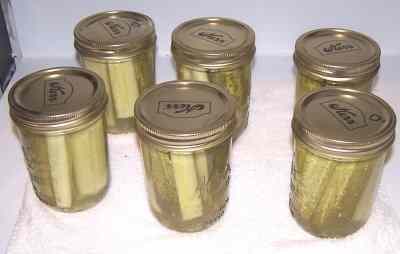 Lift
the jars out of the water and let them cool without touching or bumping
them in a draft-free place (usually takes overnight) You can then
remove the rings if you like, but if you leave them on, at least loosen
them quite a bit, so they don't rust in place due to trapped moisture.
Once the jars are cool, you can check that they are sealed verifying
that the lid has been sucked down. Just press in the center, gently,
with your finger. If it pops up and down (often making a popping sound),
it is not sealed. If you put the jar in the refrigerator right away, you
can still use it. Some people replace the lid and reprocess the jar,
then that's a bit iffy. If you heat the contents back up, re-jar them
(with a new lid) and the full time in the canner, it's usually ok.
Lift
the jars out of the water and let them cool without touching or bumping
them in a draft-free place (usually takes overnight) You can then
remove the rings if you like, but if you leave them on, at least loosen
them quite a bit, so they don't rust in place due to trapped moisture.
Once the jars are cool, you can check that they are sealed verifying
that the lid has been sucked down. Just press in the center, gently,
with your finger. If it pops up and down (often making a popping sound),
it is not sealed. If you put the jar in the refrigerator right away, you
can still use it. Some people replace the lid and reprocess the jar,
then that's a bit iffy. If you heat the contents back up, re-jar them
(with a new lid) and the full time in the canner, it's usually ok.
When can you start eating the pickles? Well, it takes some time for the seasonings to be absorbed into the pickles. That's at least 24 hours, but for best flavor wait 2 weeks! Ah... the wait...
Pickle Making Problems?
See this page for a more complete set of frequently asked pickling questions and answers
Summary - Cost of Making Homemade Pickles - makes 12 pint jars, 16 oz each* |
||||
| Item | Quantity | Cost in 2023 | Source | Subtotal |
| Cucumbers | 30-36 (about 3 per pint jar) | free from the garden, or $3.00 cents at a PYO | Pick your own | $3.00 |
| Canning jars (pint size, wide mouth), includes lids and rings | 12 jars | $12.00/dozen | Grocery stores (Publix, Kroger, Safeway, etc.) | $12.00 |
| Vinegar | 4 cups | $2 | Safeway, Publix, Kroger, grocery stores |
$2 |
| Pickle mix | 1 packet | $4.00 per package | Grocery stores (Publix, Kroger, Safeway, etc.) | $4.00 |
| Total | $21.00 total or about $1.75 per jar INCLUDING the jars - which you can reuse! |
|||
| * - This assumes you already have the pots, pans, ladles,, and reusable equipment. Note that you can reuse the jars! Many products are sold in jars that will take the lids and rings for canning. For example, Classico Spaghetti sauce is in quart sized jars that work with Ball and Kerr lids and rings. Note that the Classico's manufacturer does not recommend reuse of their jars: see what they have to say on this page: | ||||
How to make other pickles - recipes and instructions:
- Refrigerator pickles (no canning required)
- Cucumber pickle relish
- Pickled beets
- Pickled green beans
- Pickled dilled okra
Canning processing times
|
Type of pickling method |
Jar size | 0 to 1,000 ft above sea level | 1,001 to 6,000 ft above sea level |
| Quick process, (raw cucumbers put in the jar, hot liquid poured over them)- | pint | 30 min | 40 min |
| Quick process, (raw cucumbers put in the jar, hot liquid poured over them)- | quart | 30 min | 40 min |
Canning Books, Supplies and Accessories
These are my favorite essential canning tools, books and supplies. I've been using many of these for over 50 years of canning! The ones below on this page are just the sampling of. my preferred tools. but you can find much more detailed and extensive selections on the pages that are linked below.
- Vacuum Foodsealers for freezing, dried foods, and refrigerated foods - the FoodSaver line
- Selecting a KitchenAid mixer and attachments for home canning
- Steam Juicers
- Strainers, pit removers, seed-skin-stem removers, jelly strainers, etc. All types, makes and prices (from $19 to $350)
- Cherry pitters reviews, prices and ordering
- Food dehydrators - easy and fast to dry your own fruits, veggies, sun-dried tomatoes, etc.
The All New Ball Book Of Canning And Preserving: Over 350 of the Best Canned, Jammed, Pickled, and Preserved Recipes Paperback
This is THE book on canning! My grandmother used this book when I was a child.; It tells you in simple instructions how to can almost anything; complete with recipes for jam, jellies, pickles, sauces, canning vegetables, meats, etc.
If it can be canned, this book likely tells you how! Click on the link below for more information and / or to buy (no obligation to buy)The New Ball Blue Book of Canning and Preserving
Canning and Preserving for Dummies by Karen Ward
This is another popular canning book. Click here for more information, reviews, prices for Canning and Preserving For Dummies
Of course, you do not need to buy ANY canning book as I have about 500 canning, freezing, dehydrating and more recipes all online for free, just see Easy Home Canning Directions.
Home Canning Kits
See here for related tools, equipment, supplies on Amazon See here for related tools, equipment, supplies on Amazon
I have several canners, and my favorite is the stainless steel one at right. It is easy to clean and seems like it will last forever. Mine is 10 years old and looks like new.
The black ones are the same type of standard canner that my grandmother used to make everything from applesauce to jams and jellies to tomato and spaghetti sauce.
This complete kit includes everything you need and lasts for years: the canner, jar rack, Jar grabber tongs, lid lifting wand, a plastic funnel, labels, bubble freer, It's much cheaper than buying the items separately. It's only missing the bible of canning, the Ball Blue Book.
You will never need anything else except jars & lids (and the jars are reusable)!
The complete list of canners is on these pages:
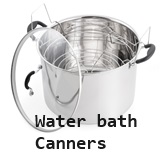
- Water bath canners - Good for acidic foods, like applesauce, pickles, salsa, jams, jellies, most fruits
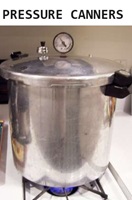
- Pressure canners - needed for low and non-acidic foods, like canned vegetables (corn, green beans, etc), and meats
- Canners for glass top stoves if you have a glass or ceramic stove
- Canners for induction stovetops
Pressure Canners
If you plan on canning non-acidic foods and low acid foods that are not pickled - this means: meats, seafood, soups, green beans corn, most vegetables, etc., then you ABSOLUTELY must use a Pressure Canner.
Of course, you can use a pressure canner as a water bath canner as well - just don't seal it up, so it does not pressurize. This means a Pressure Canner is a 2-in-1 device. With it, you can can almost ANYTHING.
There are also other supplies, accessories, tools and more canners, of different styles, makes and prices, click here!
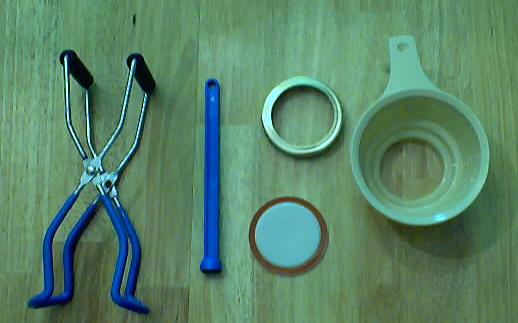
Basic Canning Accessories
From left to right:
- Jar lifting tongs to pick up hot jars
- Lid lifter - to remove lids from the pot of boiling water (sterilizing )
- Lids- disposable - you may only use them once
- Ring - holds the lids on the jar until after the jars cool - then you remove them, save them and reuse them
- Canning Jar funnel - to fill the jars
FREE Illustrated Canning, Freezing, Jam Instructions and Recipes
Don't spend money on books. that you don't need to. Almost everything you can find in some book sold online or in a store is on my website here for free. Start with theEasy Home Canning Directions below. That is a master list of canning directions which are all based upon the Ball Bblue book, the National Center for Home Food Preservation and other reputable lab tested recipes. Almost every recipe I present in addition to being lab tested com. is in a step by step format with photos for each step and complete. explanations. that tell you how to do it, where to get the supplies and pretty much everything you need to know. In addition, there almost always in a PDF format so you can print them out and use them while you cook.
[ Easy Home Canning Directions]
[FAQs - Answers to common questions and problems]
[Recommended books about home canning, jam making, drying and preserving!]

Looking for canning equipment and supplies?
Water bath canner with a jar rack
Pressure canners for gas, electric and induction stoves: Presto 23Qt or T-fal 22Qt
Canning scoop (this one is PERFECT)
Ball Blue book (most recent version)
Jars: 8oz canning jars for jams
Find Other types of farms:
Farm markets and roadside stands
Road trips and camping resources
Local Honey, apiaries, beekeepers
Consumer fraud and scams information
Home canning supplies at the best prices on the internet!
Maple Syrup Farms, sugarworks, maple syrup festivals
Environmental information and resources
Farms For Your Event for birthday parties, weddings, receptions, business meetings, retreats, etc.
Festivals - local fruit and vegetable festivals
Get the
most recent version of
the Ball Blue Book
