Strawberry Picking Tips, Facts and Recipes
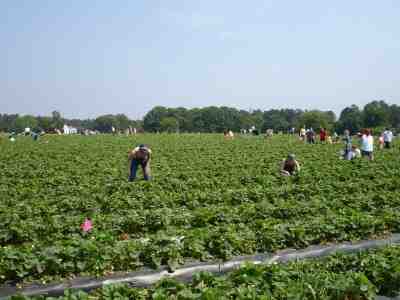
In the U.S. strawberries typically peak during April in Florida and Texas, May in the deep South, and in early June in middle sections and later June in the far North and Canada. Keep in mind that crops are ready at various times of the month depending on which part of the state you are located. In order to produce good local strawberries, producers depend on ideal spring weather conditions.
Strawberry Recipes, Canning and Freezing Strawberries
- How to freeze strawberries!
- Strawberry jam (with pectin) (uses less sugar or honey and less cooking)
- Strawberry jam (without pectin) (requires much more sugar and cooking)
- Strawberry (and other berry) jams without sugar
- Strawberry jelly
- Strawberry-rhubarb jam!
- Homemade strawberry ice cream (regular, low fat, nonfat, low sugar, vanilla and even gelato)
- Canning strawberries
- Make gourmet chocolate-covered strawberries
- How to make fruit juice - strawberry and other berries
- Strawberry pie filling
- Strawberry pie
- Easy Rhubarb-Strawberry pie
- Fig-strawberry jam
- Fig-strawberry jam, made with Jello gelatin
Strawberry Facts, Measurements and Tips
-
Picking the best strawberries:
Select firm, fully red berries. Strawberries DO NOT continue ripen after
they are picked! In the photo, only the berry on
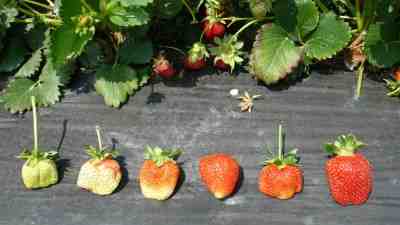 the far right is
completely ripe.
the far right is
completely ripe. - Strawberry festivals: Most areas that grow strawberries have a strawberry festival, at which you can taste all kinds of fresh strawberry foods, pies, jams, cakes - and most commonly, fresh strawberry shortcake. To find out where and when there is one near you, see this page for a list of strawberry festivals, sorted by state!
- Strawberries measurements: government agriculture
websites tell us that
1 quart = 2 pints = 4 cups and is about the same as 1 liter and
1 quart of fresh strawberries weighs 1 lbs to 1.25 lbs (or 450 to 600 g). Of course, the weight varies on variety and weather conditions.
1 quart is normally enough for 4 servings, although I'll admit my son can eat 1 pint by himself! - How much to pick? In general, 1 quart of fresh, whole, just-picked strawberries = approximately 3.5 cups hulled, whole berries. In other words, removing the caps/hulls and the occasional mushy berry means you lose 1/4 cup to 1/2 (it depends how much fruit you remove with the hull) or about 7 to 12% of every quart you pick.
- One cup of strawberries contains only about 50 calories
- U-pick strawberries are much healthier than store-bought. Consumer reports says store bought strawberries have so many pesticide and fungicide residues on they, that they don't recommend you eat them at all!
- U-pick strawberry farms typically sell berries by the pound. 1 lbs of fresh strawberries is about 2/3 of a quart.
- It takes about 10 to 15 minutes to pick a quart, if the berries are reasonably plentiful
- The strawberry plant adapts to wide variety of soil conditions, but does not tolerate drought well, and the berries quickly rot if the weather is rainy. For this reason, the plants are usually grown on raised beds through plastic mulch!
- Cultivation of strawberries began in Europe in the 1300's, but the berry only became very popular in the early 1900's in California.
- Do the math and be careful not to over-purchase as strawberries quickly mold when left at room temperature, and only last a couple of days in the refrigerator.
- You can easily freeze berries that you cannot use right away - just
wash, cut the hulls off and pop them into a ziplock bag, removing as much
air as possible. Those vacuum food sealers REALLY do a good job of
this! The berries will keep for many months frozen without air.

- Want to grow your own strawberries? Here's an article about how to: Strawberries are an Excellent Fruit for the Home Garden, HYG-1424-98!
- See this page for many more fun and interesting strawberry facts, nutritional information and trivia
Before you leave to go to the farm:
- Always call before you go to the farm - strawberries are affected by weather (both rain and cooler temperature) more than most crops. And when they are in season, a large turnout can pick a field clean before noon, so CALL first!
-
Leave
early. On weekends, then fields may be picked clean by NOON!
-
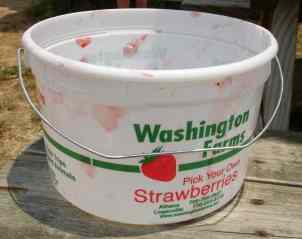 Most growers furnish picking containers designed
for strawberries, but they may charge you for them; be sure to call before you go to see if you need to bring
containers.
Most growers furnish picking containers designed
for strawberries, but they may charge you for them; be sure to call before you go to see if you need to bring
containers.
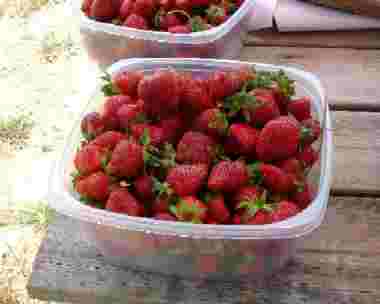 If you use your own containers, remember that heaping
strawberries more than 5 inches deep will bruise the lower berries.
Plastic
dishpans, metal oven pans with 3 inch tall sides
If you use your own containers, remember that heaping
strawberries more than 5 inches deep will bruise the lower berries.
Plastic
dishpans, metal oven pans with 3 inch tall sides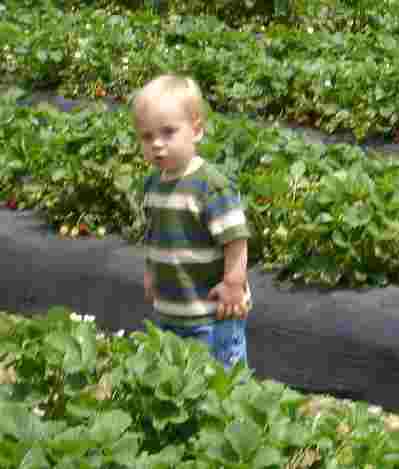 and large pots make good
containers. I like the Glad storage containers like the one at right.
and large pots make good
containers. I like the Glad storage containers like the one at right. -
Bring something to drink and a few snacks; you'd be surprised how you can
work up a thirst and appetite! And don't forget hats and sunscreen for the
sun. Bugs usually aren't a problem, but some deet might be good to bring
along if it has been rainy.
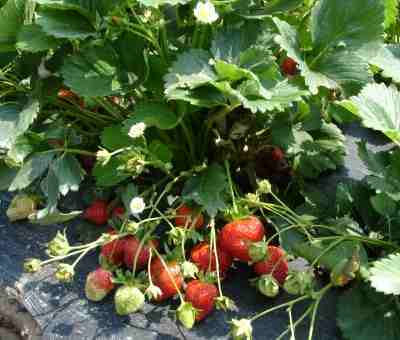
Tips on How to Pick Strawberries
- Grasp the stem just above the berry between the forefinger and the thumbnail and pull with a slight twisting motion.
- With the stem broken about one-half inch from
the berry, allow it to roll into the palm of your hand.
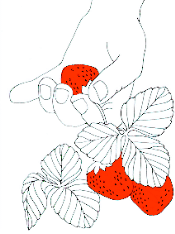
- Repeat these operations using both hands until each holds 3 or 4 berries.
- Carefully place - don't throw - the fruit into your containers. Repeat the picking process with both hands.
- Don't overfill your containers or try to pack the berries down.
General Picking Tips
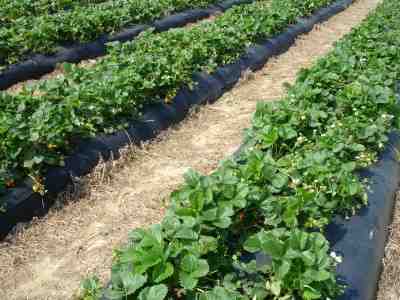 Whether you pick strawberries from your garden or at
a Pick-Your-Own farm, here are a few tips to keep in mind:
Whether you pick strawberries from your garden or at
a Pick-Your-Own farm, here are a few tips to keep in mind:
-
Be careful that your feet and knees do not
damage plants or fruit in or along the edge of the row.
- Pick only the berries that are fully red. Part
the leaves with your hands to look for hidden berries ready for harvest.
- To help the farmers, also remove from the plants
berries showing rot, sunburn, insect injury or other defects and place them
between the rows behind you. If they are left in the plants, the rot will
quickly spread to other berries.
- Berries to be used immediately may be picked any
time, but if you plan to hold the fruit for a few days, try to pick in the
early morning or on cool, cloudy days. Berries picked during the heat of the
day become soft, are easily bruised and will not keep well.
- Avoid placing the picked berries in the sunshine any
longer than necessary. It is better to put them in the shade of a tree or
shed than in the car trunk or on the car seat. Cool them as soon as possible
after picking. Strawberries may be kept fresh in the refrigerator for two or three, depending upon the initial quality of the berry. After a few
days in storage, however, the fruit loses its bright color and fresh flavor
and tends to shrivel.
- For interesting and fun strawberry facts and trivia from the California Strawberry Commission, click here!
When you get home
- DON'T wash the berries until you are ready to use them. Washing makes them more prone to spoiling.
- Pour them out into shallow pans and remove any mushed, soft or rotting berries
- Put a couple of days supply into the fridge, wash and cut the caps (green tops) off the others and freeze them up! (Unless you're going to make jam right away) See this page about how to freeze strawberries.
- If you like the strawberries you picked, ask the farm what variety they planted, and not the weather conditions the week or two before. The flavor of a strawberry is affected by the variety, the weather and the degree of ripeness when picked.
- Now, get ready to make strawberry jam. It is VERY easy - especially with our free strawberry jam instructions - they're illustrated and easy.
Other weird strawberry facts
- Strawberries are the only fruit with seeds on the outside.
- Strawberries were originally called strewberries because the fruit was 'strewn' amongst the leaves of the plant.
- California is king of strawberry productions because: California produces 75 percent of the nation's strawberry crops; one billion pounds of strawberries each year. If all the strawberries produced in California in one year were laid berry to berry, they would go around the world 15 times. Each acre of land in California in strawberry production produces an average of 21 tons of strawberries annually, with a total of 23,000 acres of strawberries planted in California each year.
More conversions
1 pint (2 cups) of fresh whole strawberries
- = about 8 oz (1/2 lb) of strawberries
- = 2.25 cups of sliced strawberries
- = 1 cup pureed strawberries
- = 12-14 large strawberries
2 quarts of fresh strawberries are needed for a 9" pie
A 10 oz package of frozen berries is about the same as 1 cup of sliced fresh strawberries
| Strawberries - Average 2020 (most recent from USDA) retail price per pound and per cup equivalent, | ||||||
| Form | Average retail price | Preparation yield factor | Size of a cup equivalent | Average price per cup equivalent | ||
| Fresh *1 | $2.58 | per pound | 0.94 | 0.320 | pounds | $0.88 |
| Frozen *2 | $2.82 | per pound | 1 | 0.331 | pounds | $0.93 |
| 1 - Includes regular strawberries. Excludes jumbo and long-stemmed varieties. The USDA National Nutrient Database for Standard Reference (SR) reports that inedible caps and stems account for 6 percent of the retail weight, implying a preparation yield of 94 percent, when strawberries are eaten raw. | ||||||
| 2 - Excludes strawberries with added sugar or other sweeteners. Includes unsweetened strawberries. Consumers are assumed to eat the berries in frozen form without further preparation. | ||||||
| Source: USDA, Economic Research Service calculations from 2020 Circana (formerly Information Resources, Inc. [IRI]) OmniMarket Core Outlets (formerly InfoScan) data; the USDA National Nutrient Database for Standard Reference (SR), Legacy Release; and the Food Patterns Equivalents Database (FPED) 2017–18 as well as the FPED's accompanying Methodology and User Guide. | ||||||
References:
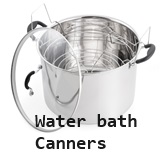

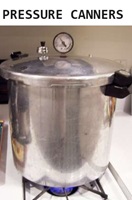
Looking for canning equipment and supplies?
Water bath canner with a jar rack
Pressure canners for gas, electric and induction stoves: Presto 23Qt or T-fal 22Qt
Canning scoop (this one is PERFECT)
Ball Blue book (most recent version)
Jars: 8oz canning jars for jams
Find Other types of farms:
Farm markets and roadside stands
Road trips and camping resources
Local Honey, apiaries, beekeepers
Consumer fraud and scams information
Home canning supplies at the best prices on the internet!
Maple Syrup Farms, sugarworks, maple syrup festivals
Environmental information and resources
Farms For Your Event for birthday parties, weddings, receptions, business meetings, retreats, etc.
Festivals - local fruit and vegetable festivals
Get the
most recent version of
the Ball Blue Book