This month's notes: June 2013: Blueberries are going strong throughout most of the US, don't wait: June through mid July is the best time for Blueberries Click here for Blueberry recipes and picking tips and here for blueberry festivals. Strawberries are finishing most places, still going in the north. Click here for strawberry facts and picking tips, and this page for easy strawberry jam making directions. Blueberries will come in June in most areas. Of course, Florida, southern Texas, and other very warm areas are already picking both crops! See this page for hundreds of easy canning and freezing instructions/recipes, canning equipment guide! Also make your own ice cream - see How to make ice cream and ice cream making equipment and manuals. Then see each state's crop availability calendar for more specific dates of upcoming crops. Organic farms are identified in green! See our guide to local fruit and vegetable festivals!. Please tell the farms you found them here - and ask them to update their information!!
Subscribe
to our: Email
alerts;
Follow us on Twitter or via RSS:
Add
this page to your favorites! -
Email this page to a friend, or to yourself
Home Pressure Canning Foods: Step by Step Instructions
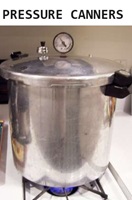
These general directions for using your pressure canner may serve as a guide and a reminder to the basic steps in home pressure canning food, but you should refer to the more specific directions that came with your pressure canner. If you lost the manual, see this page for free replacement manuals which you can download and print. Also see this page for many recipes and directions to make many foods to pressure can!
You may also find the glossary of home canning, freezing and preserving terms to be useful.
Setting up the equipment
- The first step in pressure canning is to clean, inspect and assemble the pressure canner. Before each canning season, check the dial gauge for accuracy. The dial gauge is a delicate instrument which must be handled with care. Do not submerse cover or let gauge come in contact with any liquid. You should have the gauge inspected if the cover has been submerged in water or dropped, gauge glass is broken or has fallen out, parts are rusty, pointer is not in the “0” block, or if you believe the gauge may not be accurate. The gauge can usually be checked at your local county extension office. See this page: http://www.pickyourown.org/countyextensionagentoffices.htm to find your local county agent. If you are unable to have your dial gauge checked locally, carefully remove the gauge and call your canner's Consumer Service Department for directions. Also check the sealing ring, overpressure plug, and the rubber gasket of the air vent/cover lock. Replace these parts when they become hard, deformed, cracked, worn, pitted, or unusually soft.
- Check the jars for nicks, cracks, and sharp edges. Check the rings (screw bands) for dents or rust. Use only jars, lids, and bands in perfect condition so an airtight seal may be obtained. Wash and rinse jars, lids, and bands. Pour hot water into jars and set aside until needed. The jars and lids don't need to be sterile, just clean and warm (to prevent breakage from thermal shock). The canner will sanitize both the contents and the jars!
- Put the canner on your stove, centering on the burner. If you have a glass or ceramic stove, be sure that the canner does not overextend the burner by more than 1 inch, and check the stove's manual to be sure the use of a pressure canner is ok. See this page for more information about canning on glass and ceramic stoves.
- The amount of water to put in the canner depends upon the canner, so always refer to the directions that came with your canner. The 23 quart Presto directions call for “3 quarts of boiling water, canning rack, and jars in canner. To prevent water stains on jars, add 2 tablespoons white vinegar to water in canner. Always use the canning rack that came with the canner. Jars may break if set directly on bottom of canner. In general, 3 inches of hot water into the canner. Too much water is unlikely to cause harm, but too little could boil dry and that would be a major problem. To prevent water stains on jars, add 2 tablespoons white vinegar to water in canner. Always use canning rack. Jars may break if set directly on bottom of canner.
- Start the canner heating up by turning the burner on to a low setting to warm the water. Take care not to set it too high and boil off the water or reduce the level, while you are filling the jars.
Filling the jars and canner
- Select fresh firm food. Sort food according to size. Clean
food thoroughly. Prepare according to recipe. Fill hot canning
jars promptly with food and liquid to recommended level. Allow
½-inch headspace for fruits. ALL vegetables and meats require
1-inch headspace due to expansion during processing. Work out
air bubbles with a clean nonmetallic spatula. Wipe sealing
edge clean with a damp cloth. Adjust bands according to
closure manufacturer’s directions.


- Look through the vent pipe to be certain it is open before placing cover on canner. To clean the vent pipe, draw a pipe cleaner or small brush through the opening.
- Put the cover on the canner.
For Presto brand canners, align the V mark on the cover with the V mark on the body handle and lock securely by turning in the direction indicated to close (clockwise). Cover handles must be centered over body handles. Do not force beyond this position.
Venting / Exhausting air from the canner
- Vent (exhaust) air from the canner and jars by adjusting the burner's heat to a relatively high setting to create a steady flow of steam from the vent pipe. Consult the instruction book which accompanied your range for recommended heat setting. Reduce heat to maintain a moderate steam flow. Allow steam to flow for 10 minutes to fill the canner with steam and remove air.
Sealing the canner and processing
- Place the pressure regulator [the regulator weight] on the vent pipe. Set the burner at a relatively high heat setting, on most range burners, and heat the canner until the pressure dial gauge registers desired pressure.
- The processing time begins when pressure gauge reaches the correct pressure. Adjust heat to maintain correct pressure on the dial gauge. That may take a few tweaks! For canners without dial gauges, start timing when the weighted gauge begins to jiggle or rock. One type of weighted gauge should jiggle 2 or 3 times per minute, while another type should rock slowly throughout the process – check the manufacturer’s directions.
- Notes:
- Loss of pressure at any time can result in under processing, or unsafe food.
- Quick and large pressure variations during processing may cause unnecessary liquid losses from jars.
At the end of the processing time
- At end of processing time, turn burner to “OFF” and remove canner from heat source. Lift pressure canner to remove it from burner. Sliding cookware can leave scratches on stovetops.
- Let pressure drop of its own accord, do not quick-cool. Do not run water over the canner! Pressure is completely reduced when the air vent/cover lock and overpressure plug have dropped and no steam escapes when the pressure regulator is tilted. Do not use the pressure dial gauge as an indicator for when pressure is completely reduced. Attempting to speed the cooling of the canner may cause jar breakage. Standard size heavy-walled canners require about 30 minutes when loaded with pints and 45 minutes when loaded with quarts. Newer thin-walled canners, like the Presto models, cool more rapidly and are equipped with vent locks that are designed to open when the pressure is gone. These canners are depressurized when the piston in the vent lock drops to a normal position. Often you can hear a click when it drops.
- When the pressure has been completely reduced, remove pressure regulator from vent pipe and let canner cool for 10 minutes. Do not remove the pressure regulator until pressure is completely reduced and the air vent/cover lock has dropped. Always remove pressure regulator before opening the cover.
- Open the canner. Note: take care when
opening a hot canner! Lift the canner cover toward you to keep steam away from
you when opening.
For Presto canners, to remove the cover, turn counterclockwise until cover hits stop. Cover handles will be beyond the body handles. If cover seems to stick or is hard to turn, do not force it open. Sticking may indicate that there is still pressure inside the canner. If in doubt about pressure being completely reduced, let the canner stand until cool before removing the cover. - Remove jars from canner with a jar lifter, trying to keep them upright without tilting. Set jars apart on board or cloth away from draft to cool. A towel or cake cooling rack makes a good surface. Leave at least one inch of space between the jars during cooling. Let the jars sit undisturbed while they cool, normally 8 to 12 hours. Do not tighten the ring bands on the lids or push down on the center of the flat metal lid while the jars are cooling.
- Once the jars are cooled, remove ring bands from sealed jars (otherwise the bands may rust in place and be hard to open). If necessary, wash jars and lids to remove all residues Put any unsealed jars in the refrigerator and use those first.
- When jars are cold, test seal, remove bands, wipe jars, label, date, and store in a cool, dry place. Most canner foods will taste good for about a year. Technically, they are safe for years past this, as long as they remained sealed, stored properly and show no signs of spoilage. But after a year or two the quality and taste will appreciably decline.
Problems and solutions
- Altitudes above sea level - Recipes normally include directions for the proper pressure and processing time if you are more than 1,000 ft above sea level.
- Failure to vent trapped air - When you seal the canner, it has water, jars and air (O2, N2, CO2, etc.) in it. The air trapped in a pressure canner has different thermodynamic properties than steam (H2O) and lowers the temperature, which results in under processing. For this reason, we vent pressure canners for 10 minutes before the weights are put on and they are pressurized.
- Dial gauge malfunctions - Dial gauges should be checked for accuracy each year before use. If the gauge reads high or low by more than one pound at 5, 10 or 15 pounds pressure, replace it. Weighted gauges are always accurate. If your canner has both gauge and weight, also go by the weight using the gauge as a guide only.
- Canning jars, lids and rings - While there are many styles and shapes of glass jars on the market, only canning jars are recommended for home canning. canning jars are available in ½ pint, pint, and quart capacities with threads on which a cap may be screwed. See the chart below for the jar capacity of your canner. Additional information may be obtained from the manufacturers of canning jars. CLOSURES FOR canning jars: The two-piece vacuum cap consists of a flat metal lid held in place with a screw band. A rubber compound on the underside of the lid forms a seal during processing. Follow the closure manufacturer’s directions for using the two-piece cap and for testing for a proper seal. If the closure has not sealed, completely reprocess or use the food immediately. Refer to the closure manufacturer’s directions for additional information.
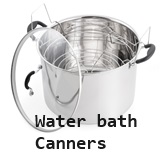
See below for prices, descriptions and ordering options for pressure canners. For water bath canners and other supplies, see this page! If you have a glass top radiant stove, see Canners for glass top stoves?
For other supplies:
- Books on canning, freezing, drying, preserving and jam making
- Strainers, pit removers, seed-skin-stem removers, jelly strainers, etc. All types, makes and prices (from $19 to $350)
- Vacuum Foodsealers for freezing, dried foods, and refrigerated foods - the FoodSaver line
- Canning Lids and Rings,
- Canning jars,
- Canning mixes, pectin, etc.
- And just for fun, the history of the canning jar
You can also find free information from the USDA in this PDF file (it will take a while to load!) about selecting and using canners here!
For more information, and NO obligation to buy, just click on the links in the Amazon boxes on the left!
| Canning all sorts of fruit and vegetables, even meat with a pressure canner it's easy. And although a pressure canner costs $100 to $200 (see this page for pressure canners models, makes and prices), they last a lifetime, and your children and grandchildren may be using it. You can also find free information from the USDA in this PDF file (it will take a while to load!) about selecting and using canners here! |
Picking Tips>
[General picking tips and a guide to each fruit and vegetable] [How
much do I need to pick?
(Yields - how much raw makes how much cooked or frozen)] [Selecting
the right varieties to pick] [All
about apple varieties - which to pick and why!] [Picking tips for Vegetables]
[ Strawberry picking tips]
[ Blueberries picking tips]
Illustrated Canning, Freezing, Jam Instructions and Recipes
[ All About Home Canning, Freezing and Making Jams, Pickles, Sauces, etc. ] [FAQs - Answers to common questions and problems] [Recommended books about home canning, jam making, drying and preserving!] [Free canning publications to download and print]