Looking for Figs: Picking Tips, Facts and Recipes in 2025? Scroll down this page and follow the links. And if you bring home some fruit or vegetables and want to can, freeze, make jam, salsa or pickles, see this page for simple, reliable, illustrated canning, freezing or preserving directions. There are plenty of other related resources, click on the resources dropdown above. If you are having a hard time finding canning lids, I've used these, and they're a great price & ship in 2 days.
If you have questions or feedback, please let me know! There are affiliate links on this page. Read our disclosure policy to learn more.
Figs: Picking Tips, Facts and Recipes: Great things to make from fresh figs
Fig Facts and Picking Tips
 Many
Americans have never eaten a fresh fig. I blame fig newtons and dried figs
- those are NOTHING like a fresh fig. A fresh fig tastes like a mix of a
peach and a strawberry!
Many
Americans have never eaten a fresh fig. I blame fig newtons and dried figs
- those are NOTHING like a fresh fig. A fresh fig tastes like a mix of a
peach and a strawberry!
In the U.S., Figs typically peak from July through first frost in the South, and from August and later in the North. Usually the trees produce a crop within a month, and then nothing for several months, so check your local farm to find out when they will be in season. In the north, most trees only produce one crop per season. In order to produce good local Figs, producers depend on ideal spring and early summer weather conditions, and no late frosts.
Fig Varieties.
There are hundreds of fig varieties but the following are most commonly found in U.S. farms and markets.
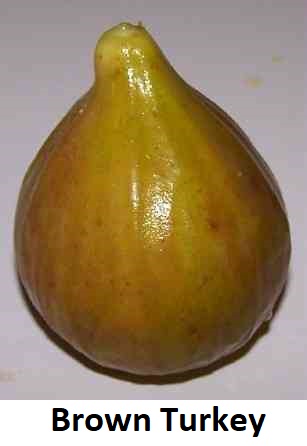
Brown Turkey Figs: has brownish / copper-colored skin, often with hints of purple, and mostly pink/red flesh with some white flesh. This variety is used exclusively for the fresh fig market and is common at PYO farms..
Celeste figs are about the size of an egg, a purplish-brown when ripe, and a dark, sweet, moist, purple flesh inside.
The Calimyrna Fig: Is known for its nut-like flavor and golden skin. This type is commonly eaten as is.
The Mission Fig: Was named for the mission fathers who planted the
fruit along the California coast. This fig is a deep purple which darkens to a
rich black when dried. Often called "black mission figs".
The Kadota Fig: Is the American version of the original Italian Dattato fig, that is thick-skinned with a creamy amber color when ripe. Practically seedless, this fig is often canned and dried. A similar variety is the "Peter's Honey" fig. Birds often leave these alone, because, since they are green when ripe, the birds don't know they're ripe!
How to know when a fig is ripe
Color - Figs come in all colors from yellow, brown, red to purple, black and others! So you need to know what color the ripe fig is. The most commonly grown figs, Brown Turkey and Celeste are a golden yellow as shown at left when ripe.
Texture - Ripe Figs Become soft like a peach when ripe, but they should not be mushy or fall apart!
Fig Picking Tips
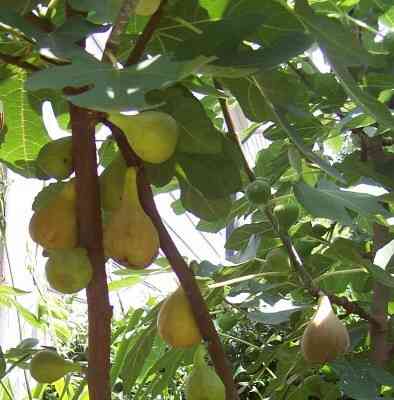 |
Figs grown on low, open trees, with no thorns and soft leaves, so they're very easy to pick! The ripe figs will separate easily from the tree when you lift them upwards from their normal drooping position. The ripe figs definitely droop a bit and feel softer. Unripe figs are harder, more firmly attached and do not droop. Note the orange, drooping Celeste figs at left. |
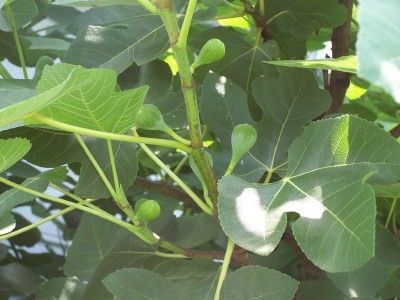 |
Figs must be picked ripe from the trees, since they do not ripen once picked. See the photo of unripe figs at left. They are small, hard, and not their proper color. Of course, there are some figs, like LSU Gold, Peter's Honey, or Italian figs that are greenish-yellow when ripe, too. |
Fig sap allergy?
I have heard and verified that some people are allergic to the fig latex, a milky white liquid produced by the fig tree and develop contact rashes. Just like with other latex allergies, if this applies to you be sure to wear and long sleeves when you pick and wear the appropriate type of gloves when picking or handling figs!
Storing fresh figs
Figs won't last long at room temperature, but a mildly cool refrigerator will keep them several days.
Freezing Figs
Freeze within 12 hours of picking time, if possible. Prepare and freeze Figs only about 3 pints at one time. Then repeat the process until all Figs are frozen.
- Make a medium sweetness syrup of
3 cups sugar
4 cups water
The figs will taste slightly sweeter than desired at this stage to be the proper flavor after freezing. Simply stir the sugar into the water to dissolve. No heating is necessary. - To the sugar syrup, add an citric/ascorbic add mixture bought at the grocery store (for example, "Fruit Fresh") and follow the directions on the package, generally adding about 1 teaspoon per batch. This is to help preserve color and flavor.
- Wash the figs. remove the stems and any soft spots. Slice the figs about 1/4-inch (1/2 cm) thick.
- Pack the sliced figs into polyethylene containers, ziploc bags, or vacuum freezer bags, allowing room to add about 1/2 cup of sugar syrup, and allowing about 1/2 inch per pint expansion room. More room will be needed for larger containers. Pack the containers to force out as much air as possible since air dries out the figs when they freeze. Be sure to label and date containers.
- Place containers as quickly as possible into the coldest part of your freezer, allowing room around the containers to promote fast freezing. Containers can be packed more economically after they are frozen solid, usually 24 hours.
When you are ready to eat them, thaw the frozen figs in the refrigerator in the container.
Fig Preserving and Recipes:
- How to Make Homemade Fig Preserves and Fig Jam
- How to make fig-strawberry jam.
- How to Can Figs
- Making Candied figs
- Fig bread or fig cake
- Related: Banana bread
- Other fig recipes
- See this page from Purdue University for more information about figs
|
||||
Variety |
Fruit Color |
Fruit Size |
For Fresh Use |
For Jams and Preserves |
| Adriatic ( also called Fragola, Strawberry Fig, Verdone, White Adriatic) | Greenish skin, flesh is strawberry colored | Small to medium | Good | Good |
| Alma | Greenish brown | Small | Very good | Good |
| Black Mission | Black purple skin with Flesh watermelon to pink, |
Medium | Good | Good. Easily dried at home. |
| Brown Turkey | Bronze ( yellow/brown) | Medium to large | Good | Excellent |
| Celeste | Lt. brown to violet | Medium | Very good | Excellent |
| Green Ischia | Bright green | Medium | Good | Good (seeds objectionable) |
| Hunt | Dull bronze with specks | Small to medium | Good | Excellent |
| Italian Honey fig, Peter's Honey | skin yellowish green, flesh white to amber | Medium to large | Very good, very sweet, lemon flavor |
Very good |
| Kadota | Bright greenish-yellow | Medium to large | Fair | Excellent |
| Magnolia | Bronze with white flecks |
Medium | Fair | Excellent |
Other variants are:
- There are five varieties of Celeste: giant, blue, golden, improved and regular.
- LSU gold and purple;
- Smith, which has a scarlet interior;
- Clement, a Mediterranean variety;
- Alma;
- Hardy Chicago; and
- Camelle.
- More information: see Figs 4 Fun: Said to be the largest database of information about figs (Ficus carica) that is available on the internet.
Nutritional Information
Figs Serving Size 1/2 cup raw (74g)
| Amounts Per Serving | % Daily Value |
|---|---|
| Calories 90 | |
| Calories from Fat 0 | |
| Total Fat 0g | 0% |
| Saturated Fat 0g | 0% |
| Cholesterol 0mg | 0% |
| Sodium 0mg | 0% |
| Total Carbohydrate 24g | 8% |
| Dietary Fiber 2g | 7% |
| Sugars 11g | |
| Protein 1g | |
| Vitamin A | 15% |
| Vitamin C | 25% |
| Calcium | 0% |
| Iron | 2% |
* Percent Daily Values are based on a 2,000 calorie diet.
Below is the USDA's Food Value Per 100 g of Edible Figs
| Fresh | Dried | |
| Calories | 80 | 274 |
| Moisture | 77.5-86.8g | 23.0g |
| Protein | 1.2-1.3g | 4.3g |
| Fat | 0.14-0.30g | 1.3g |
| Carbohydrates | 17.1-20.3g | 69.1g |
| Fiber | 1.2-2.2 g | 5.6 g |
| Ash | 0.48 0.85 g | 2.3 g |
| Calcium | 35-78.2 mg | 126 mg |
| Phosphorus | 22-32.9 mg | 77 mg |
| Iron | 0.6-4.09 mg | 3.0 mg |
| Sodium | 2.0 mg | 34 mg |
| Potassium | 194 mg | 640 mg |
| Carotene | 0.013-0.195 mg | 0 |
| as Vitamin A | 20-270 I.U. | 80 I.U. |
| Thiamine | 0.034-0.06 mg | 0.10 mg |
| Riboflavin | 0.053-0.079 mg | 0.10 mg |
| Niacin | 0.32-0.412 mg | 0.7 mg |
| Ascorbic Acid | 12.2-17.6 mg | 0 mg |
| Citric Acid | 0.10-0.44 mg |
Note: There are small amounts of malic, boric and oxalic acids.
Growing tips
Climate
While there is some variation among varieties of figs, most like hot climates but can tolerate temperatures down to 10 F to 20 F with mulch or in favorable sites. If it gets and stays colder than that, any above ground growth will be killed off and the tree can regrow from the roots in the Spring. Of course, if it stays that cold for long, the roots can die, too. Brown Turkey, Brunswick and Blue Celeste are more cold tolerant than most of the others.
Figs like a dry climate with light early spring rains. Too much water during fruit development and ripening can be detrimental to the crop, causing the fruits to split. But very hot, dry spells will cause fruit-drop even if the trees are irrigated.
Location
Figs require full sun most of the day to ripen. Trees can become enormous, and will shade out anything growing beneath. Roots spread, traveling far beyond the tree canopy. Figs are not a fruit tree for tight quarters. The fine roots that invade garden beds, however, may be cut without loss to the tree. In areas with short (less than 120 days between frosts), cool summers, you cvan prune the trees to grow against a southern-facing wall (called an espalier). If you are growing them in a container; replace most of the soil in the tub every three years and keep the sides of the tub shaded to prevent overheating in sunlight.
Soil and Fertilizer
The fig can be grown on a wide range of soils; light sand, rich loam, heavy clay or limestone, providing there is sufficient depth and food drainage. Sandy soil that is medium-dry and contains a good deal of lime is preferred when the crop is intended for drying. Highly acid soils are unsuitable. The pH should be between 6.0 and 6.5. The tree is fairly tolerant of moderate salinity.
Pests and Diseases
Gophers like to eat fig tree roots. Deer are not particularly attracted to fig trees or fruit, but birds can cause a lot of damage, pecking at the ripe fruits. Varieties that are green or yellow when ripe tend top attract fewer birds.
Nematodes, particularly in sandy soils, attack roots, forming galls and stunting the trees. Mitadulid and Carpophilus dried fruit beetles can enter ripening fruit through the eye and cause damage by introducing fungi and rots. They frequently breed in fallen citrus fruits. Keep a clean orchard by destroy fallen fruits and do not grow near citrus trees.
Mosaic virus, formerly considered benign, probably causes crop reduction. Symptoms resemble potassium deficiency--leaves are marbled with yellow spots, and the veins are light colored. Symptoms are often not apparent until the tree is older or when it becomes heat or water-stressed. .
Propagation
Fig trees are easily propagated through cuttings. In September or October, make a cutting and put it in a bucket with potting soil, or simply stick it in the ground and cover with mulch. One out of 10 will take, but once you've got a fig tree going, it's hard to kill. Protect it the first winter from frost with a deep mulch, and then it's on its own. After three years, it should start producing.
A reader suggests that the following method has a much higher rate of success. I've tried it and it does work well:
Take a low-growing branch, about quarter to half inch (5 - 15 mm) diameter, and bury part in the soil. Put a stone or brick on top of the submerged section to stop it getting pulled out by wind or passing animals. After a year it will have rooted. Cut the parent branch and pot up or plant out the new plant.
Fig Preserving Directions
- Click here for my fully illustrated, easy fig jam directions!
- How to can figs
- Candied figs
- Other fig recipes
Frequently Asked Questions About Figs
- Q: I don't have enough ripe figs to make a batch of jam yet - how
do I keep the ones I've picked until I have enough to make jam? Can I make
jam from frozen figs - if I use your method to freeze?
A: I just prepare them as if I were going to use them (in jam making or whatever) by washing, then cutting the stems off and peeling them (I like them peeled), then I pack them in a ziploc bag and pop them in the freezer. A few weeks in the freezer like that till I accumulate enough to make jam, won't hurt them! I've keep them in the freezer as long as several months until I made jam!
- Q. Is it possible to be allergic to figs? I get an itchy rash that
looks like poison ivy after handling them.
A. Yes, others have reported allergic reactions to handling and eating figs. See this scientific report on the subject. Skin reactions are more common after handling hot peppers and mangos (see this page for more information) but it is not unheard of with figs.
Canning booksCanning & Preserving for Dummies by Karen Ward Get Canning and Preserving For Dummies |
|
The All New Ball Book Of Canning And Preserving: Over 350 of the Best Canned, Jammed, Pickled, and Preserved Recipes PaperbackThis is THE book on canning! My grandmother used this book when I was a child. It tells you in simple instructions how to can almost anything; complete with recipes for jam, jellies, pickles, sauces, canning vegetables, meats, etc. If it can be canned, this book likely tells you how! Click on the link below for more information and / or to buy (no obligation to buy) Click here for more information about the Ball Blue Book of Preserving |
| McSunley 21.5 quart Water Bath Canner, Stainless Steel Granite Ware 21 QT, 9 Piece Enamelware Water bath Canning Pot with Canning kit, Colander and Rack VKP Brands Water Bath AND Steam Canner, 20 Quart Stainless Steel, flat-bottomed Induction range compatible and safe for smooth top ranges. 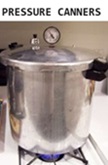
|
Home Canning KitsSee the seller's website for more information, features, pricing and user reviews! This is the same type of standard canner that my grandmother used
to make everything from applesauce to jams and jellies to tomato and
spaghetti sauce. This complete kit includes everything you need and lasts
for years: the canner, jar rack, Jar grabber tongs, lid lifting wand, a
plastic funnel, labels, bubble freer, and the bible of canning, the Ball
Blue Book. It's much cheaper than buying the items separately. You will never need anything else except jars & lids! To see more canners, of different styles, makes and prices, click here!For
more information and current pricing:
|
|
|
Lids, Rings, Jars, mixes, pectin, etc.Need lids, rings and replacement jars? Or pectin to make jam, spaghetti sauce or salsa mix or pickle mixes? Get them all here, and usually at lower prices than your local store! |

Looking for canning equipment and supplies?
Water bath canner with a jar rack
Pressure canners for gas, electric and induction stoves: Presto 23Qt or T-fal 22Qt
Canning scoop (this one is PERFECT)
Ball Blue book (most recent version)
Jars: 8oz canning jars for jams
Find Other types of farms:
Farm markets and roadside stands
Road trips and camping resources
Local Honey, apiaries, beekeepers
Consumer fraud and scams information
Home canning supplies at the best prices on the internet!
Maple Syrup Farms, sugarworks, maple syrup festivals
Environmental information and resources
Farms For Your Event for birthday parties, weddings, receptions, business meetings, retreats, etc.
Festivals - local fruit and vegetable festivals
Get the
most recent version of
the Ball Blue Book
