Looking for Roasted Peppers: How to Make Your Own Home Roasted Peppers (complete directions with photos) in 2025? Scroll down this page and follow the links. And if you bring home some fruit or vegetables and want to can, freeze, make jam, salsa or pickles, see this page for simple, reliable, illustrated canning, freezing or preserving directions. There are plenty of other related resources, click on the resources dropdown above. If you are having a hard time finding canning lids, I've used these, and they're a great price & ship in 2 days.
If you have questions or feedback, please let me know! There are affiliate links on this page. Read our disclosure policy to learn more.
Roasted Peppers: How to Make Your Own Home Roasted Peppers (complete directions with photos)
How to Make Homemade Roasted Peppers
using hot or sweet peppers, including Bell peppers, banana, chilies, jalapeno, and
pimiento's
Click here for a PDF print version!
Roasted peppers are expensive in the grocery stores; but they're EASY to make at home! Here's how to make your own roasted peppers! The directions are complete with instructions in easy steps and completely illustrated. While it is not considered safe by the USDA, FDA and University food science labs to can them at home, you can refrigerate them or freeze them!
Prepared this way, the roasted peppers have a fridge shelf life of about 2 months.
Directions for Making Roasted Peppers
Ingredients
Peppers (see step 1)
Optional:Seasoning: herbs d' Provence, Italian spices, basil, Thyme, whatever you like!
Equipment
- Gar or charcoal grill or an oven or a stovetop (called a "cooker" in the U.K.)
- Tongs
- Rubber or latex gloves (if your skin is sensitive to capsicum!)
|
|
Recipe and Directions
Step 1 - Selecting the peppers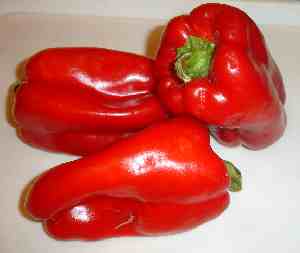
The most important step! You need peppers that are FRESH and crisp. Limp, old peppers will make nasty tasting roasted peppers. Guests will probably throw them at you.. Select filled but tender, firm, crisp peppers. Remove and discard any soft, diseased, spotted and rusty pods. Select small peppers, preferably 1 inch to 1 and 1/4-inch in diameter. Larger peppers are often too fibrous and tough.
Hot pepper caution: Wear plastic or rubber gloves and do not touch your face while handling or cutting hot peppers. If you do not wear gloves, wash hands thoroughly with soap and water before touching your face or eyes. Hot peppers can burn your eyes and skin - ever heard of pepper spray?
How many peppers and where to get them
You can grow your own, pick your own, or buy them at the grocery store. An average of 9 pounds is needed per canner load of 9 pints jars. A bushel of peppers weighs 25 pounds and yields 20 to 30 pints canned; an average of 1 pound per pint
Step 2 -Wash the peppers!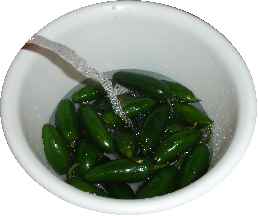
I'm sure you can figure out how to rinse the peppers in plain cold or lukewarm water.
Ste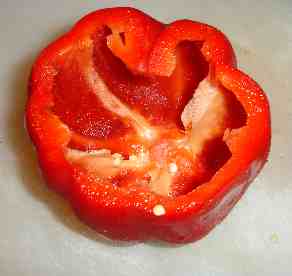 p 3 - Cut the stem end off the peppers and remove the seeds
Small peppers may be left whole. Large peppers may be quartered. Remove cores and seeds. Slash two or four slits in each pepper
Step 4 - Blister the peppers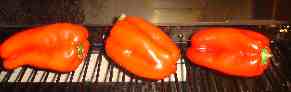
Peppers have a skin that turns REALLY tough when you can the peppers, so you've got to remove the skin before canning. Fortunately, there is an easy trick to remove the skins. It's called "blistering". Just heat up a fry pan to medium hot, and lay the peppers in there skin side down. In just a few minutes, the skin will start bubble up and darken - that's blistering - once cooled, the skin peels off easily by hand.
Here are some other methods for how to blister peppers:
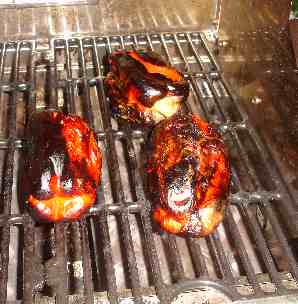
Outdoor grill method: this is the easiest method - Place
peppers on a charcoal or gas grill about 5 to 6 inches above glowing
coals; using tongs carefully turn peppers frequently (skin side down if
they are cut up), exposing all surfaces to the heat source until skin
blisters evenly on all sides.
Oven or broiler method: Place peppers in a hot oven or broiler set
at 400º to 450ºF (205º to 232ºC) for 6 to 8 minutes; using tongs
carefully turn pepper often until skin blisters evenly on all sides.
Stove top method: Place peppers on wire mesh over a hot electric
or gas burner; using tongs carefully turn peppers frequently, exposing
all surfaces to the heat source until skin blisters evenly on all sides.
Microwave oven method: Place peppers in a microwave
safe dish; cover with secure air-tight lid to allow
for steam build up. Place container on rotating plate in
the center of the oven, then microwave for 7 to 8 minutes
depending the oven wattage and power level (settings
may vary depending on microwave oven used). The blistering is not
visible with this method. However, the skin will have a tougher, more
brittle texture compared to the raw pepper. Allow steam to fully develop
in the covered container for 1to 2 minutes after microwave cooking.
Caution: The hot steam will be released from container when the lid is
opened - don't get burned!
Step 4 - Allow the peppers to cool
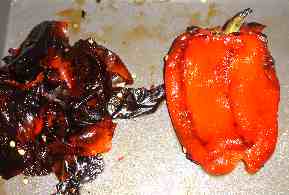 Allow them to cool until you can comfortably handle them (about 20 to
30 minutes). You don't want to burn your hands, do you? Allow the
peppers to cool by placing them in a pan and cover with a damp cloth.
This will make peeling the peppers easier.
Allow them to cool until you can comfortably handle them (about 20 to
30 minutes). You don't want to burn your hands, do you? Allow the
peppers to cool by placing them in a pan and cover with a damp cloth.
This will make peeling the peppers easier.
Comments from a visitor on August 16, 2009: "My husband learned to roast peppers from his mother which is using the outdoor grill method that you describe. But he was able to also teach his mother a new trick. After you take the peppers off of the grill, place in a paper bag and allow to cool. The skins peel right off. I think it works the same as what you do with the towel.
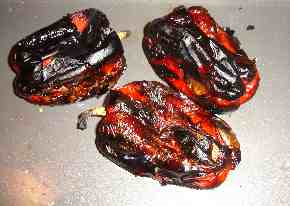
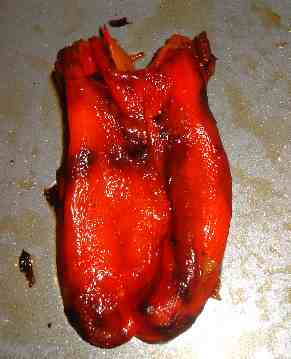 Step 5 - Peeling the Peppers
Then pull the blistered skin off the rest of the pepper with a gentle tug and an occasional rinse with water. In areas of the pepper where the blistering was not complete, just scrape the skin off with a knife or vegetable peeler.
Step 6 - Finish up!
You can rinse the peppers under the facet to get off any remaining seeds or debris, if you wish, or just scrape them with a knife! they're ready to eat! You can also season them with olive oil and spices, typically Italian seasonings like oregano, thyme, basil!
Keep them in the refrigerator for up to 2 months, or freeze them in ziploc bags (or better still, vacuum bags)!
Other Equipment:
From left to right: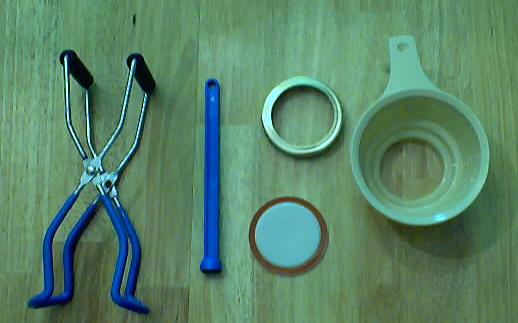
- Jar lifting tongs
helpful to pick up hot jars - Lid lifter
- to remove lids from the pot
of hot water - Lids
- disposable - you may only
use them once - Ring
- holds the lids on the jar until after
the jars cool - then you remove them, save them and reuse them - Canning Jar funnel
- to fill the jars
Frequently Asked QuestionsQ. Is it safe to can roasted peppers in a traditional water bath? If so how long do you do process them? A. The answer, quite simply is no. Quoting from the Ohio State University Extension's Fact Sheet:
And Clemson
University provides these questions and answers:
Salt and sugar are not preservatives for vegetables: they are added to stabilize and improve flavor, but will not prevent spoilage. Salicylic acid is also NOT a preservative. The University of Illinois reports:
Think of it like smoking. We all know someone who smoke their entire life and lived to be 90. But the cemeteries are filled with the vast majority who didn't. You will hear people say "my grandmother did it that way for 20 years". But of course, the people who died from food poisoning aren't around and often didn't have descendants to tell their tale...
|
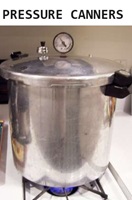
Pressure canners!If you want to can low-acid foods such as red meats, sea food, poultry, milk, and all fresh vegetables with the exception of most tomatoes, you will need a Pressure Canner. These foods fit into the low acid group since they have an acidity, or pH level, of 4.6 or greater. The temperature which must be reached and maintained (for a specified amount of time) to kill the bacteria is 240 F. Pressure canning is the only canning method recommended safe by the U.S.D.A. for low-acid foods such as vegetables, meats, and fish. Ordinary water bath canners can only reach 212 F and cannot to kill the types of bacteria that will grow in low acid foods. This temperature can be reached only by creating steam under pressure as achieved in quality pressure canners. There are several manufacturers of pressure canners. The two leading ones are Presto and All American (Wisconsin Aluminum). They are more expensive than water bath canners, but extremely well built - I bought mine in 1988 and it still looks and works like new!
|
|||
|
Presto 01781 23-Quart Pressure Cooker/CannerThis is usually one of the best-priced pressure canners. They are reliable and inexpensive. I've had mine for 40 years. There is also a 16 quart version for even less. Click on the links at left or above for more info and current pricing. |
||
|
|
Shown at left is the Presto 23 quart pressure canner. Features below and
click here for more information or to purchase from Target.
 See the seller's website for features, pricing and user reviews! |
||
| All-American 915 pressure canner All-American 930 Pressure Canner |
All American Pressure Canner and Cooker #921See the seller's website for features, pricing and user reviews! |
||
| Canning kit with Stainless Steel Steam Rack,Canning Funnel, Jar Lifter, Jar Wrench, Lid Lifter, Canning Tongs, Bubble Remover Tool | |||
|
|
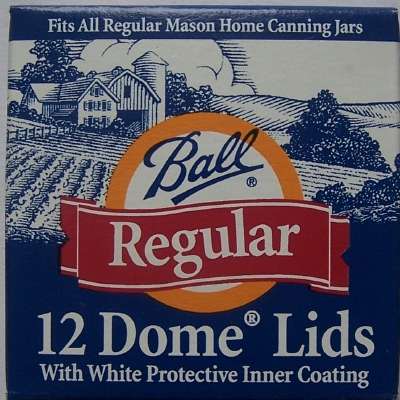
Lids, Rings, Jars, mixes, pectin, etc.Need lids, rings and replacement jars? Or pectin to make jam, spaghetti sauce or salsa mix or pickle mixes? Get them all here, and usually at lower prices than your local store! |
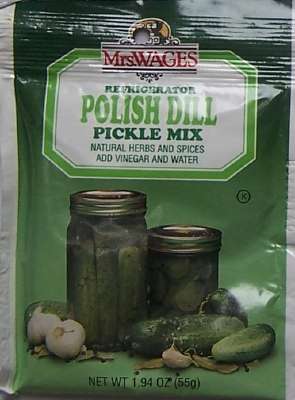

Looking for canning equipment and supplies?
Water bath canner with a jar rack
Pressure canners for gas, electric and induction stoves: Presto 23Qt or T-fal 22Qt
Canning scoop (this one is PERFECT)
Ball Blue book (most recent version)
Jars: 8oz canning jars for jams
Find Other types of farms:
Farm markets and roadside stands
Road trips and camping resources
Local Honey, apiaries, beekeepers
Consumer fraud and scams information
Home canning supplies at the best prices on the internet!
Maple Syrup Farms, sugarworks, maple syrup festivals
Environmental information and resources
Farms For Your Event for birthday parties, weddings, receptions, business meetings, retreats, etc.
Festivals - local fruit and vegetable festivals
Get the
most recent version of
the Ball Blue Book
