Looking for How to can your make and own mango chutney in 2025? Scroll down this page and follow the links. And if you bring home some fruit or vegetables and want to can, freeze, make jam, salsa or pickles, see this page for simple, reliable, illustrated canning, freezing or preserving directions. There are plenty of other related resources, click on the resources dropdown above. If you are having a hard time finding canning lids, I've used these, and they're a great price & ship in 2 days.
If you have questions or feedback, please let me know! There are affiliate links on this page. Read our disclosure policy to learn more.
How to can your make and own mango chutney
How to Make Homemade Mango Chutney
Click here for a PDF print version
 You
think making and canning your own mango chutney is difficult or
expensive? Not at all! Here's how to do it, complete
instructions in easy steps and completely illustrated. In the winter
when you open a jar, the mangoes will taste MUCH better than anything
you've ever had from a store, and by selecting the right fruit, it will
use less sugar than store-bought canned mangoes. Don't let the
list of ingredients worry you; they're all readily available at any
grocery store! Best of all, you can refrigerate it OR can it for later
use.
You
think making and canning your own mango chutney is difficult or
expensive? Not at all! Here's how to do it, complete
instructions in easy steps and completely illustrated. In the winter
when you open a jar, the mangoes will taste MUCH better than anything
you've ever had from a store, and by selecting the right fruit, it will
use less sugar than store-bought canned mangoes. Don't let the
list of ingredients worry you; they're all readily available at any
grocery store! Best of all, you can refrigerate it OR can it for later
use.
Prepared this way, the jars have a shelf life of about 12 to 18 months, and aside from storing in a cool, dark place, require no special attention.
You may also be interested in How to make mango salsa and Mango-raspberry jam and how to can mangoes.
Directions for Making and Canning Mango Chutney
Yield: 7 - 8 eight-ounce jars
Ingredients
- 6 mangoes, slightly under-ripe (total weight about 3 lb/1.5 kg) You will need about 5 to 6 cups of chopped mango.
- 2 cups brown sugar
- 2/3 teaspoon cumin seeds or ground cumin, if you can't get the seeds
- 1 cup raisins
- 1 teaspoon ground coriander
- 1/4 teaspoon cinnamon
- 1 teaspoon red cayenne pepper
- 1/2 teaspoon ground turmeric
- 1.5 teaspoon ginger paste (available from Asian grocery stores, otherwise, 2 teaspoons of dried ginger)
- 1/2 teaspoon ground cloves
- 3 cups red wine vinegar or apple cider vinegar
- 2 teaspoon garlic paste or puree
- 1 large onion (finely chopped ) about 3/4 cup
Equipment
- Jar grabber (to pick up the hot jars)
- Lid lifter (I like the lid rack that holds 12 lids or you can pull them out one at a time with the lid-lifter that has a magnet from the almost-boiling water where you sanitize them. ($4 at mall kitchen stores and local "big box" stores, but it's usually cheaper online from our affiliates)
- Jar funnel ($4 at mall kitchen stores and local "big box" stores, but it's usually cheaper online from our affiliates)
- At least 1 large pot
- Large spoons and ladles,
- Canning jars (often called Ball jars, Mason jars or Kerr jars) (Publix, Kroger, other grocery stores and some "big box" stores carry them - now about $12 per dozen quart jars (up 50% in 2 years!) including the lids and rings)
- 1 water bath canner (a huge pot with a lifting rack to sanitize the jars of mangoes after filling (about $30 to $35 at mall kitchen stores and local "big box" stores, but it's usually cheaper online from our affiliates) You CAN use a large pot instead, but the canners are deeper, and have a rack top make lifting the jars out easier. If you plan on canning every year, they're worth the investment.
Recipe and Directions
Step 1 - Selecting the mangoes
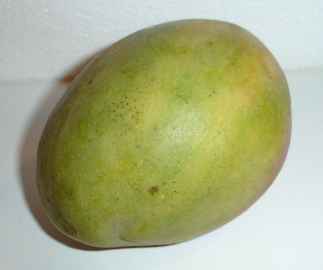 Choose
ripe, mature fruit of ideal quality for eating fresh or cooking. They
should not be mushy, but they also should not be rock hard: just as ripe
as you would eat them fresh. You can also use solid green mangoes.
Select firm, non-fibrous fruit.
Caution: Handling green mangoes may irritate the skin of some
people in the same way as poison ivy. (They belong to the same plant
family.) (see
this page for more information) To avoid this reaction, wear plastic
gloves while working with raw green mango. Do not touch your face, lips
or eyes after touching or cutting green mangoes until all traces are
washed away.
Choose
ripe, mature fruit of ideal quality for eating fresh or cooking. They
should not be mushy, but they also should not be rock hard: just as ripe
as you would eat them fresh. You can also use solid green mangoes.
Select firm, non-fibrous fruit.
Caution: Handling green mangoes may irritate the skin of some
people in the same way as poison ivy. (They belong to the same plant
family.) (see
this page for more information) To avoid this reaction, wear plastic
gloves while working with raw green mango. Do not touch your face, lips
or eyes after touching or cutting green mangoes until all traces are
washed away.
Step 2 - How many mangoes and where to get them
You can pick your own, or buy them at the grocery store. But for large quantities, you will find that Costco, Sam's Club and BJ's seem to have the largest mangoes and best prices.
Step 3 - Wash the jars
and lids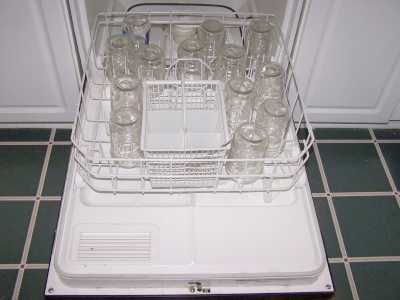
This is a good time to get the jars ready! The dishwasher is fine for the jars; especially if it has a "sanitize" cycle. Otherwise put the jars in boiling water for 10 minutes. I just put the lids in a small pot of almost boiling water for 5 minutes, and use the magnetic "lid lifter wand" (available from target, other big box stores, and often grocery stores; and available online - see this page) to pull them out.
Step 4 -Wash the mangoes!
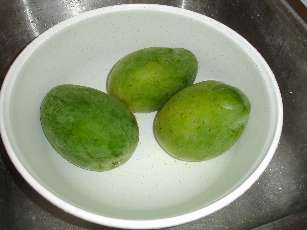 I'm
sure you can figure out how to wash the mangoes in plain cold or
lukewarm water.
I'm
sure you can figure out how to wash the mangoes in plain cold or
lukewarm water.
Step 5 - Peeling the Mangoes
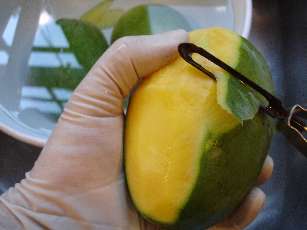 Green
mangoes are fairly firm, so a regular vegetable peeler works pretty
well. This is probably the most tedious step of the process, though.
Green
mangoes are fairly firm, so a regular vegetable peeler works pretty
well. This is probably the most tedious step of the process, though.
Step 6 - Cut up the mangoes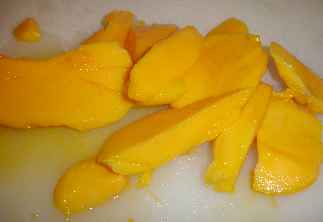
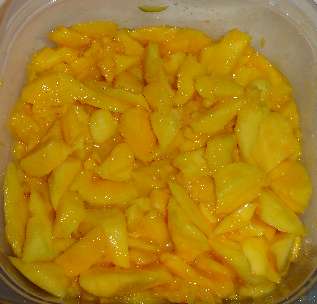 Cut
out any brown spots and mushy areas. Slice the mangoes in 1/4 thick
slices! It just takes practice to figure out where the pit is. the
pit is sort of flat, rather than egg-shaped, so you will get more flesh of
some parts of the mango than others.
Cut
out any brown spots and mushy areas. Slice the mangoes in 1/4 thick
slices! It just takes practice to figure out where the pit is. the
pit is sort of flat, rather than egg-shaped, so you will get more flesh of
some parts of the mango than others.
Then chop the mango slices up into 1/4 to 1/2 inch pieces. You will need about 5 to 6 cups of chopped mango
See here for related tools, equipment, supplies on Amazon This mango splitter works great!
Step 7 - Add the spices
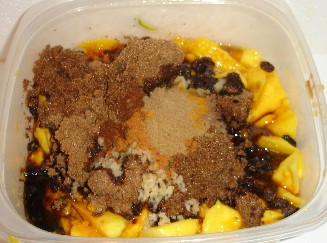 Add
the spices: 2 cups brown sugar, 2/3 teaspoon cumin, 1 cup raisins, 1 teaspoon
ground coriander, 1/4 teaspoon cinnamon, 1 teaspoon red cayenne pepper, 1/2
teaspoon ground turmeric, 1.5 teaspoon ginger paste, 1/2 teaspoon ground cloves,
3 cups vinegar, 2 teaspoon garlic puree and 1 large onion (finely chopped )
about 3/4 cup, to the chopped mangoes.
Add
the spices: 2 cups brown sugar, 2/3 teaspoon cumin, 1 cup raisins, 1 teaspoon
ground coriander, 1/4 teaspoon cinnamon, 1 teaspoon red cayenne pepper, 1/2
teaspoon ground turmeric, 1.5 teaspoon ginger paste, 1/2 teaspoon ground cloves,
3 cups vinegar, 2 teaspoon garlic puree and 1 large onion (finely chopped )
about 3/4 cup, to the chopped mangoes.
If you want it spicier, you could safely double the dry powder spices.
Step 8 - Cook the mango chutney
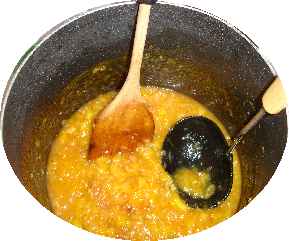 Simmer
over low heat for 30 to 90 minutes - the goals is just to thicken it to the
consistency you desire! When it cools, it will thicken further, so there's
no need to cook it to death!
Simmer
over low heat for 30 to 90 minutes - the goals is just to thicken it to the
consistency you desire! When it cools, it will thicken further, so there's
no need to cook it to death!
Step 9 - Fill the jars
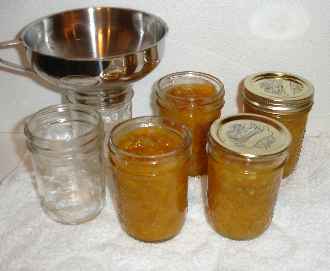 Wipe
rim and screw threads with a clean damp cloth. Add lid, screw band and
tighten firmly and evenly. Do not over tighten.
Wipe
rim and screw threads with a clean damp cloth. Add lid, screw band and
tighten firmly and evenly. Do not over tighten.
Step 10 - Process the jars in the water bath
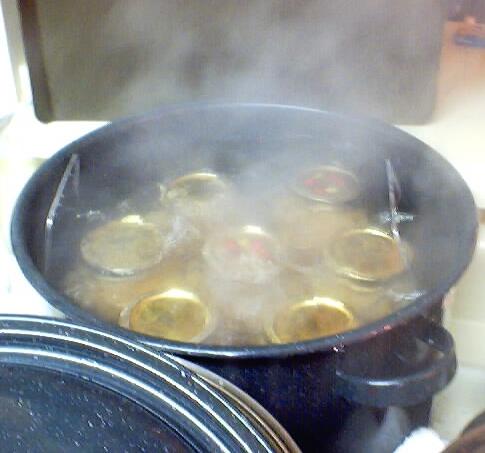 Put
the sealed jars in the canner and keep them cover with at least 1 inch
of water and boiling. Boil them for at least 20 minutes (and no more
than 30 min).
Put
the sealed jars in the canner and keep them cover with at least 1 inch
of water and boiling. Boil them for at least 20 minutes (and no more
than 30 min).
| Recommended process time for Mangoes in a boiling-water canner. | |||||
| Process Time at Altitudes of | |||||
| Style of Pack | Jar Size | 0 - 1,000 ft | 1,001 - 3,000 ft | 3,000 - 6,000 ft | Above 6,000 ft |
| Hot | Pints Quarts |
15 min 20 |
20 25 |
20 30 |
25 35 |
Step 11 - Remove and cool
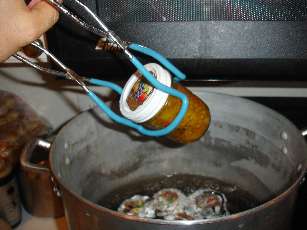 Lift
the jars out of the water and let them cool without touching or bumping
them in a draft-free place (usually takes overnight), here they won't be
bumped. You can then remove the rings if you like, but if you leave them
on, at least loosen them quite a bit, so they don't rust in place due to
trapped moisture. Once the jars are cool, you can check that they are
sealed verifying that the lid has been sucked down. Just press in the
center, gently, with your finger. If it pops up and down (often making a
popping sound), it is not sealed. If you put the jar in the refrigerator
right away, you can still use it. Some people replace the lid and
reprocess the jar, then that's a bit iffy. If you heat the contents back
up, re-jar them (with a new lid) and the full time in the canner, it's
usually ok.
Lift
the jars out of the water and let them cool without touching or bumping
them in a draft-free place (usually takes overnight), here they won't be
bumped. You can then remove the rings if you like, but if you leave them
on, at least loosen them quite a bit, so they don't rust in place due to
trapped moisture. Once the jars are cool, you can check that they are
sealed verifying that the lid has been sucked down. Just press in the
center, gently, with your finger. If it pops up and down (often making a
popping sound), it is not sealed. If you put the jar in the refrigerator
right away, you can still use it. Some people replace the lid and
reprocess the jar, then that's a bit iffy. If you heat the contents back
up, re-jar them (with a new lid) and the full time in the canner, it's
usually ok.
Mangoes, pears and apples may also show a blue, red
or pink color change after canning. This is the result of natural chemical
changes that sometimes occur as fruits are heated. It is harmless and won't
affect flavor!
Also, avoid storing canned food near heat sources such as a furnace,
water heater, hot water or sunny areas. Jars need to be kept cool and
dark for longer storage life and to protect against spoilage. Be sure to
store in a dry place. If the lid or band rusts, that can cause the seal to
break.
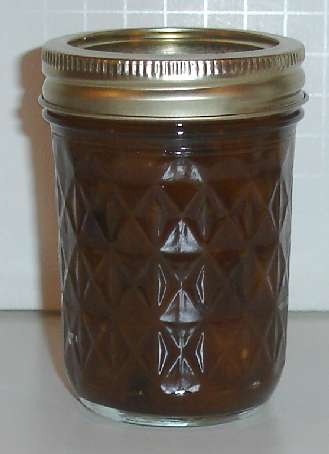
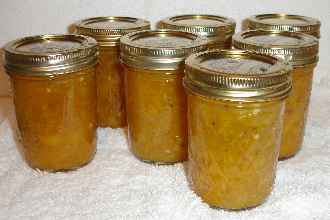 Your
chutney will probably be darker in color than these and look more like the
single jar shown.
It depends upon how much spice you use and how long you cook it.
Your
chutney will probably be darker in color than these and look more like the
single jar shown.
It depends upon how much spice you use and how long you cook it.
Other Equipment:From left to right:
|
 You can get all of the tools in a kit here: See here for related tools, equipment, supplies on Amazon |
Frequently asked questions! |
|

Looking for canning equipment and supplies?
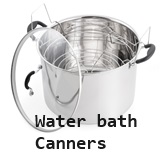
Water bath canner with a jar rack
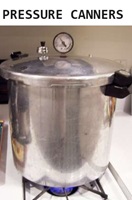
Pressure canners for gas, electric and induction stoves: Presto 23Qt or T-fal 22Qt
Canning scoop (this one is PERFECT)
Ball Blue book (most recent version)
Jars: 8oz canning jars for jams
Find Other types of farms:
Farm markets and roadside stands
Road trips and camping resources
Local Honey, apiaries, beekeepers
Consumer fraud and scams information
Home canning supplies at the best prices on the internet!
Maple Syrup Farms, sugarworks, maple syrup festivals
Environmental information and resources
Farms For Your Event for birthday parties, weddings, receptions, business meetings, retreats, etc.
Festivals - local fruit and vegetable festivals
Get the
most recent version of
the Ball Blue Book